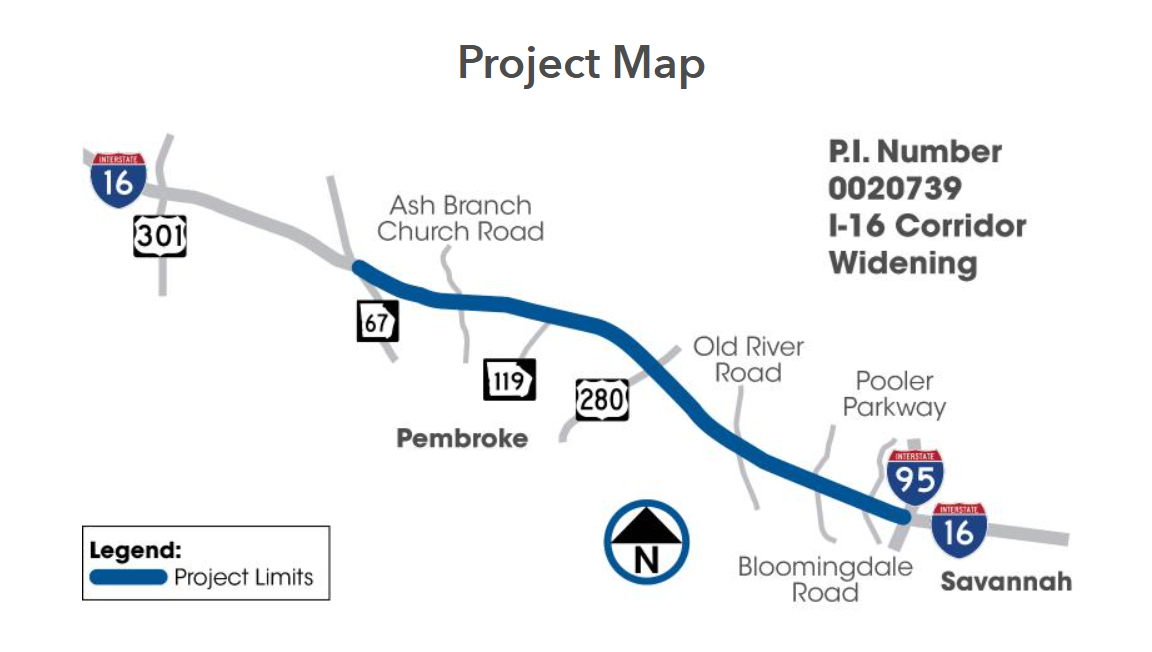
SOUTHEAST GA – The Georgia Department of Transportation announced, July 2, that it selected an engineering firm for its Interstate 16 Widening Project, the state’s largest Design-Build project ever awarded.
Matthews-McLendon Joint Venture Infrastructure Consulting and Engineering LLC was awarded the $468.35 million contract for the widening project from Interstate 95 to State Road 67, across Bryan, Bulloch, Chatham and Effingham counties. However, this first phase’s stretch of corridor is only 17.77 miles of the originally planned 32-plus miles. The engineering firm will construct the first segment of the project from the I-16/I-95 interchange to mile marker 139.65 in Bryan County.
Kyle Collins, GDOT communications manager, wrote in an email that GDOT doesn’t “have clarity” on the phase to complete all 32-plus miles “at this time;” although, the National Environmental Policy Act documentation includes the entire corridor stretch.
“This initial segment was advanced using strategic state funding due to the high priority placed on safety and freight mobility along this corridor,” Collins wrote.
The Design-Build approach places design and construction under one contract to “shorten schedules and reduce delays.”
Three qualified proposer teams were shortlisted in January 2026, and responsive proposals were submitted from two proposer teams which were opened on June 26, 2026, in a virtual bid opening event.
This was only the Department’s third time using a Best Value procurement method with a variable scope, which allowed flexibility to get the most from the industry for such a large project. A press release read that “using innovation in contracting allows Georgia DOT to stretch available funding and ultimately deliver more to the traveling public.”
The I-16 Widening Project includes the expansion of I-16 east and westbound from two to three lanes, existing pavement improvements and enhanced design to improve safety and long-term roadway performance.
Along the project limits, six bridges will be replaced, and six will be widened in the following locations:
- Ogeechee River (EB and WB will be replaced)
- Little Ogeechee River (EB and WB will be widened)
- Ogeechee River Overflow 1 (EB and WB will be widened)
- Ogeechee River Overflow 2 (EB and WB will be widened)
- Ogeechee River Overflow 3 (EB and WB will be replaced)
- Georgia Central Railway (EB and WB will be replaced)
The project, which is considered a critical corridor supporting economic development and regional mobility, received strong support from Gov. Brian Kemp and was fully funded by the state.
“The widening of I‑16 is an essential step to keep pace with the rapid growth and increasing freight activity across southeast Georgia,” Rick O’Hara, Georgia DOT Project Manager, said. “By expanding the corridor and strengthening its infrastructure, we’re improving safety and ensuring this route continues to reliably serve the communities and industries that depend on it. We look forward to working with Matthews‑McClendon on delivering this important project.”
Collins clarified that the project is the largest Design-Build project GDOT has ever awarded that does not involve a Public-Private Partnership.
“GDOT has delivered larger projects in metro Atlanta—such as the I‑285/I‑20 interchange improvements, the I‑285/SR 400 interchange reconstruction, and the SR 400 Express Lanes—but those projects included private financing elements,” he wrote. “The I‑16 widening is the largest non‑P3 Design‑Build contract awarded in Georgia.”
Construction for this first phase is expected to start in 2027 and be completed in Q3 of 2031.
Collins wrote that the previously cited $520-million project cost range reflected a “conservative, all-in planning estimate that included construction, inspection, overhead and other contingencies for budgeting purposes.”
He wrote that GDOT does not have a cost estimate for the remaining portion to SR-67 in Bulloch County.
“The remaining portion of the 32-plus-mile … corridor that is not included in this phase will be delivered at a later date as funding becomes available,” Collins wrote. “If funding becomes available, it would be procured just like this design build contract was delivered.”