SOUTHEAST GEORGIA – Across southeast Georgia’s coastal plains and fast-growing industrial corridors, local leaders are bracing for an industry that hasn’t fully arrived but is already driving policy debates: data centers.
Georgia has become a hub for these facilities — large buildings housing IT infrastructure such as servers and data storage systems. Nearly 4,000 data centers operate across the U.S., with about 200 in Georgia. Tech companies have been drawn by tax breaks estimated to cost state and local governments about $2.5 billion in fiscal year 2026.
Lawmakers considered several data center bills during the 2026 legislative session, including proposals to eliminate tax credits or impose stricter regulations. Georgia was one of a slew of states that considered moratorium bills to impose a temporary ban on their construction – just recently Maine became the first state to pass a ban of this kind.
However, Georgia lawmakers failed to pass new rules on data centers this year, leaving southeast Georgia communities to navigate one of the fastest-growing industries in the country on their own.
Leaders in Bryan, Bulloch, Effingham and Liberty counties say no formal proposals have been submitted, though early discussions are ongoing.
“We recognize the growth that is coming out of Savannah … the port is one of the busiest in the country,” Bulloch County Commission Chairman David Bennett said. “There's a lot of data that's going through there and they're trying to put these data centers as close as they can. It's only a matter of time before somebody's going to come around knocking on our door saying they want to put a data center here. I just want to make sure that we're prepared when it happens.”
A boom without a blueprint: Local leaders try to be proactive
Some southeast Georgia leaders are saying no to data centers while others are fielding inquiries.
Largely, leaders said interest has been exploratory.
In Bryan County, County Commission Chairman Carter Infinger said data centers are not permitted under current ordinances, responding to a public commenter requesting the county consider a moratorium during the April Commission meeting.
“There’s nothing to put a moratorium on,” Infinger said.
In Liberty County, Jeff Ricketson, the executive director of the Liberty Consolidated Planning Commission said the county received a data center inquiry for Riceboro, “a couple years ago,” but the conversation never progressed. Ricketson said the county’s water restrictions make it an unattractive site for data centers along with other industries with heavy water usage.
In both Bulloch and Effingham counties, leaders said they are taking a proactive approach as interest in data centers grows.
Bulloch County enacted a 90-day moratorium on data centers in February to study the facilities. Bennett said the goal is to get ahead of a fast-growing industry. The county will host a public hearing on the issue during its regular meeting, May 5.
“We know of no proposals for data centers trying to come to Bulloch County,” Bennett said. “We’re not even going to consider it until we can get a plan in place.”
Meanwhile at the municipality level, Statesboro leaders are listening to queries about smaller data centers, even brainstorming vacant properties that could be used for them.
Bulloch officials have since been gathering information, consulting with statewide zoning experts and hearing from groups, including Georgia Power and the Ogeechee Riverkeeper. Bennett said leaders are now drafting zoning regulations to define where and how data centers could be built, with an emphasis on protecting agricultural land and requiring infrastructure standards, such as closed-loop cooling systems to reduce water usage.
Potential economic benefits
Bennett said the goal is to get a clear picture of potential economic benefits – including significant tax revenue with relatively low demand on public services – vs. long-term risks, such as facilities becoming obsolete.
A data center can be anywhere from 5,000 square feet (small load) to more than 500,000 square feet (large load). Local elected officials tout the potential for the large facilities that contain high tech equipment to generate significant local property tax revenue. Bennett said he spoke with leaders in Columbia County who suggested the construction of data centers would “pretty much eliminate property taxes there.”
Bennett said data centers also do not employ many full-time workers – about 50 per facility but sometimes fewer.
“It generates a lot of property tax revenue, which you can then use to offset other people's property taxes, and it doesn't put a big strain on your infrastructure as far as schools, public safety, people driving on the roads,” he said. An analysis for the Georgia Department of Audits and Accounts, released in December 2025, reported that the total average value for each data center project across the state approached $2.3 billion, leading to an average of nearly $28 million in annual property tax proceeds per project.
However, Bennett said he is skeptical about the long-term future for data centers as technology evolves. The Georgia Public Service Commission passed a rule allowing Georgia Power to enforce 15-year minimum contracts for new “high-load” data centers. This is to protect taxpayers from “stranded costs” if a data center leaves early.
Bennett said those safeguards may not fully address future risks, especially as technology quickly evolves.
“You build a data center here and that technology becomes obsolete, you can't throw that thing out. We're stuck with it forever,” he said. “For 15 years it's generated millions of dollars of revenue for the county, and then all of a sudden… they pack up and leave. Now you're not getting anything.”
Effingham County actions
In neighboring Effingham County, officials report a similar level of early interest. Effingham County Industrial Development Authority CEO Brandt Herndon said the IDA has fielded “several” data center inquiries.
“If we get any inquiries, we research them all,” he said. “We talk to anybody who calls us … large companies, small companies, auto manufacturers. That's what we're supposed to do.”
Herndon said Effingham is not actively recruiting data centers, and the IDA’s recruitment focus is on light industries. But as data centers gain traction statewide, Herndon said local leaders are still weighing the potential tradeoffs.
“Like any economic development project … there’s always pros and there’s always cons,” he said. “You obviously want the pros to outweigh the cons.”
He noted the same potential pros and cons that Bulloch County is weighing. Herndon said any potential data center development would likely be steered toward existing industrial parks with established infrastructure and buffers from residential areas.
He emphasized transparency to the public if a more concrete data center development plan were to come into play.
Effingham County Manager Tim Callanan said county leadership has begun discussing how to set clear expectations, particularly around natural resource protection. Any future project, he said, would require a water and sewer agreement, with conservation measures such as closed-loop cooling systems.
“Even though the county has ample water supply, we still think that you still have to act in a responsible way,” Callanan said.
Data center opposition
Community opposition toward data centers has already grown strong with community groups hosting towns halls and proposing petitions against the facilities.
A question on whether Bulloch County officials should allow the building of data centers in the county will be included on at least Republican Party ballots for the upcoming May election.
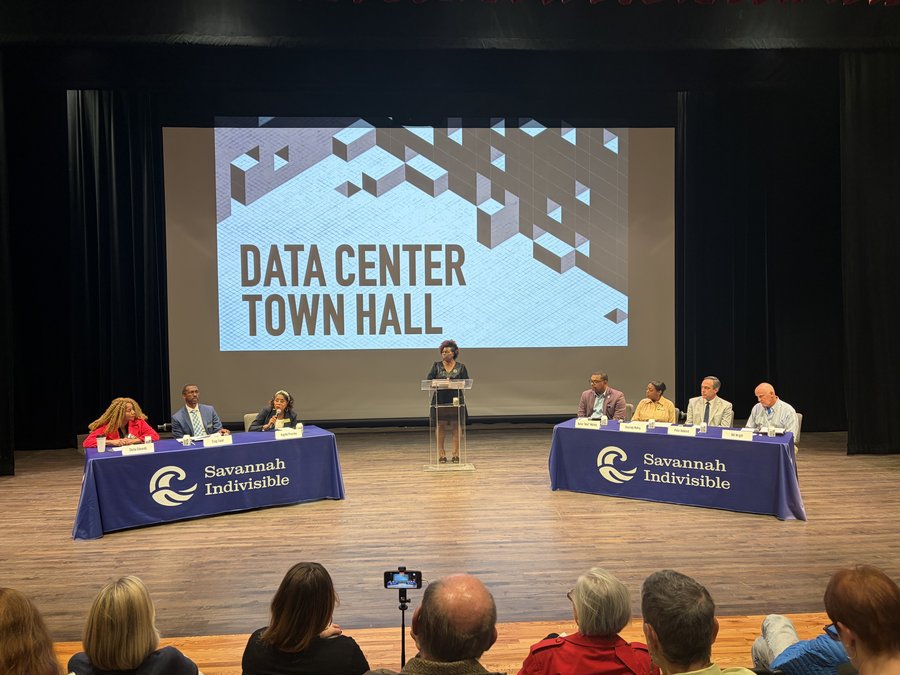
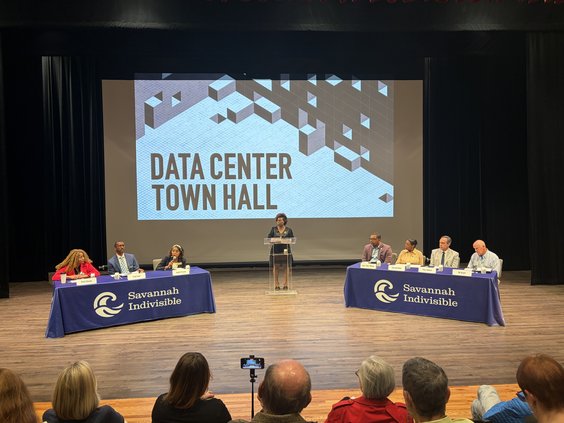
At an April data center town hall in Savannah, Peter Hubbard, a public service commissioner, said the 15-year PSC contract has a loophole.
“It is possible to get out of that contract in less than 15 years,” he said. “You can give notice and then pay another two years and then pay another two years on top of that. So, with four years of payments, you can get out of paying the full 15.”
Chassidy Malloy, with Georgia Conservation Voters, an environmental advocacy group, said the costs and impacts from data centers are already being felt by everyday utility customers. Beyond electricity and water use, Malloy said issues such as constant noise, heat generation and land clearing have raised questions about how these projects would harm southeast Georgia communities.
“Data centers are not good neighbors,” she said.
Kristen Stampfer, a Bulloch County resident and founder of Coastal Communities United, a regional non-profit, said already existing environmental pressures and rapid development make southeast Georgia not a good fit for data centers.
“I do not think they should be coming to this region at all, especially when we have so many water issues already,” she said. “I think we are just way too rapidly developing and using far more water than we should be.”
Stampfer said she’s also concerned about education and transparency surrounding data centers. She’s been requesting information specifically in Effingham County because of rumors circulating about a potential data center project. She said records requests made to the County Communications came back with no responsive records and requests made to the IDA were denied.
She said she’s also concerned about elected officials listening to presentations from Georgia Power – what she called a one-sided education. Georgia Power asked for and got approval for a nearly 10-gigawatt expansion with 80% of that output slated for current and future data centers from the PSC in December .
“I think they need to have a real education program … if they are actually considering allowing these,” Stampfer said. “There's no transparency. They really need to listen to citizen input. I think the NDA things that they do and the back door deals really need to be stopped and put out in the open.”
She urged leaders to listen to environmental advocates.
“Data centers take way more than they give back to the communities,” Stampfer said. “They take too much in resources and power that the people end up paying for.”
Lucille Lannigan is a growth and development reporter for Morris Multimedia. Reach her at llannigan@morrisnews.com.