
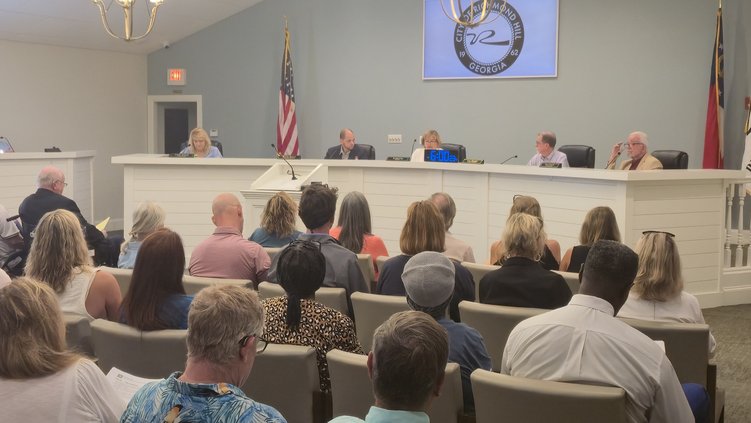
RICHMOND HILL — A zoning appeal tied to the controversial proposed Westwin Elements nickel refinery came to an end Tuesday, as Richmond Hill officials unanimously affirmed that nickel refining is not a permitted use at the former Caesarstone facility on Belfast Commerce Park.
The decision effectively closes an appeal filed by Caesarstone, a countertop manufacturing company that closed its doors in Richmond Hill, January 2024, and reinforces the city's determination that Westwin would need to seek rezoning approval before operating a nickel refinery at Caesarstone’s former site at 1 Caesarstone Drive in Belfast Commerce Park.
A line of public attendees ran out the door of Richmond Hill’s city hall. Law enforcement began turning people away because of capacity limits in the building. Members of the public remained outside, waiting for information.
Before discussion began, Councilmember Van Hunter recused himself from the proceedings due to a legal conflict.
Aaron Kappler, the Bryan County Attorney, presented a timeline of events pertaining to Westwin as well as requested clarifications on the site’s zoning from Caesarstone.
This site was zoned in 2013 as part of the Belfast Commerce Center Level II Planned Development District. Within that district, the property falls under a general commercial/general industrial planning area that includes specific permitted uses, conditional uses requiring additional approvals, and prohibited uses.
In June 2025, the Development Authority of Bryan County asked city staff about the zoning classification of the former Caesarstone property. At that time, no site plans, permit applications, or detailed descriptions of Westwin's intended operations had been submitted to city officials.
City staff responded that the property was located within the Belfast Commerce Center Planned Unit Development (PUD) and that general manufacturing involving metallurgy was listed as a permitted use under the zoning designation.
"Nothing happens then," Kappler said.
The situation changed in January 2026 when Westwin applied for an air permit through the Georgia Environmental Protection Division. Kappler said the application provided more specific information about the company's plans to refine nickel and other metals using a carbonyl process.
Following a public town hall in February, where Westwin CEO KaLeigh Long discussed the project and concerns about conditions at the former Caesarstone facility, Richmond Hill officials directed city staff to reevaluate whether the proposed refinery was allowed under existing zoning.
Kappler said Richmond Hill Planning and Zoning Director Brian Crooks reviewed the Unified Development Ordinance, the planned development district and the project's details before concluding that nickel refining, cobalt refining and other heavy metal refining activities were not permitted uses at the site.
On Feb. 6, Crooks issued a letter informing Westwin that the refinery could not proceed under the current zoning and would require additional approval through a rezoning process.
City regulations provided a 15-day window to appeal that determination. Westwin never appealed. Instead, Caesarstone filed an appeal, challenging Crooks' interpretation, arguing that nickel refining should be considered a permitted manufacturing activity.
That appeal led to this week's hearing.
Kappler shared with Richmond Hill’s city council that he negotiated a resolution with Caesarstone’s attorneys, who were not present at Tuesday’s meeting.
Under the agreement, Caesarstone acknowledged that Crooks' interpretation was correct and agreed that nickel refining, cobalt refining, and other heavy metal refining operations are not permitted uses on the property under current zoning.
Kappler recommended that city officials affirm Crooks' interpretation while adding four clarifications.
The clarifications state that the property remains governed by the Belfast Commerce Center Level II PDD approved in 2013; that it is located within the district's general commercial/general industrial planning area; that the uses specifically permitted within the PDD remain valid; and that nickel, cobalt and other heavy metal refining operations, whether through a carbonyl process or other methods, are not permitted under the zoning designation.
Officials unanimously approved the resolution, ending the appeal and affirming the city's zoning interpretation.
The decision marks another setback for Westwin Elements, which has faced growing opposition since plans for the refinery became public.
The Oklahoma-based company, founded in 2022, has sought to purchase the former Caesarstone facility as part of its effort to establish a domestic supply chain for critical minerals. Company leaders have argued that refining nickel in the United States is important for national security and reducing dependence on foreign sources.