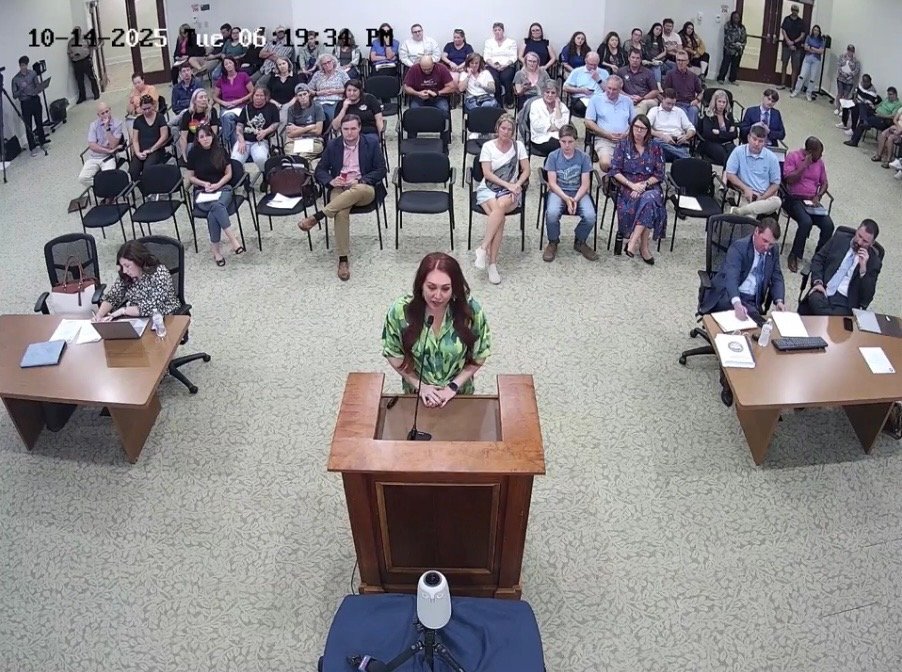
Richmond Hill resident Amy Mitchell has become a regular presence at meetings of the Bryan County Board of Commissioners, urging its members to adopt a historic preservation ordinance to help protect the county’s historic places.
Here’s a Q&A with Mitchell on her efforts.
Q: First, what's your background, and how did you wind up being the one to petition the county commission?
A: Professionally, I am a real estate agent. I went to school for business-marketing. In college, I fell in love with historic homes and that is really where my appreciation for history and architecture began. During school, I visited Richmond Hill and remember thinking how beautiful and tucked away it was. I loved the trees, the water and the architecture of the historic homes. Life took me to a few neighboring towns but I eventually moved to Richmond Hill. I got involved with local historic preservation and served on the board of the Richmond Hill Historical Society and later as president. I have always loved serving the community in various ways, and after coming off the board, I stayed involved in conversations surrounding local history.
As our area has grown, there has naturally been more discussion among residents about what that growth means for our history, character and culture. Many people have expressed concern about the risks facing historic structures and sites, and eventually I decided to step up and take action with the county. I don't necessarily want to be "the guy" but my job affords me the flexibility to be able to attend meetings, so I have dedicated myself to the cause and I have some really fantastic and knowledgeable supporters that I am actively working with behind the scenes.
I am just a regular resident. A mom. A small business owner. But I moved to Richmond Hill because it was beautiful and I valued small town culture. Many people feel that we are losing that identity as we experience rapid growth. Although we cannot stop the growth, we can grow responsibly and protect what remains. I grew up in a town that reminds me a lot of Richmond Hill. When I was young, it was dirt roads and farms. The county became known for quality education and, as we are seeing here, development exploded. By the time I graduated high school, it was unrecognizable and so much of the culture was lost. I never moved back.
I see those same patterns here and I know many property owners who plan to leave, or already have, because of how dramatically things are changing. The very least we can do is protect our history and structures that remain. As of today, 483 signatures have been collected in support of creating a county wide historic preservation ordinance. The county, in response, put out a survey in December, in which 90 percent of respondents were in support of a historic preservation ordinance. Only two people said one wasn't needed.
All different types of people responded to this survey -- citizens, historic property owners, business owners, etc., all are overwhelmingly in support. Because of the response, I feel obligated to continue to push for action from the county. Historic preservation is also included as part of the county's comprehensive plan and I believe it is important to remind our elected officials of what their constituents have identified as a priority.
Q: On that note, how many meetings of the commission have you spoken at?
A: I have spoken at nine County Commissioner meetings, every month since August 2025.
Q: Are you getting frustrated that this process has taken so long? How would you characterize the county's position on the issue?
A: I would be lying if I said I wasn't frustrated but, more so, I am concerned with the lack of response or proactiveness. I have taken a lot of time to research and provide the county with any resource I can get my hands on. I have delivered the information both verbally and physically during public comment and also electronically via email. Multiple Commissioners have admitted to not reading the information and, because of that, there have been a lot of misunderstandings regarding the process. The state makes it pretty straightforward and clear but, without understanding the process, unfounded objections can develop. It is hard not to feel like the community’s concerns are not truly being heard when time isn't being taken to learn or ask questions. If we started today, and the Commissioners directed staff to draft an ordinance, it would still take months or years before it was fully in effect.
The state already provides a model ordinance, and I have personally written and submitted a draft for them to work from. Drafting the ordinance and appointing a Historic Preservation Commission (HPC) is just the beginning. From there, surveys have to be completed, districts formed, design guidelines created, etc. The appointed HPC would oversee these steps but they do take time.
The longer the Commissioners delay action, the more we are at risk of losing historic sites and structures. Time is of the essence. The county has also raised concerns about property rights, which is a valid concern. I tend to be Libertarian, if anything, with a "less is more" kind of outlook. But with the growth we are experiencing, it feels irresponsible not to protect our historic assets.
There is a way to do this that benefits both the community and property owners. The county could provide tax incentives to owners preserving historic sites or structures. Financially, adopting an ordinance could also allow the county to become a Certified Local Government, opening the door to grants and support from the state.
Q: Do you feel you are making progress on an ordinance?
A: I do but it has felt painfully dragged out. I truly do not mean to be a pest and I understand that the Commissioners have a lot of important issues on their plates but this is important, too. Multiple Commissioners that I have spoken with, one on one, have been really kind and supportive, even encouraging me to keep going with our efforts. However, going to meetings to say the same thing in different ways, hoping that it will "click," is tiring. It would be so simple to make a motion for staff to draft the ordinance. Staff has told me that they could start immediately, if directed to do so.
Q: Why is an ordinance necessary and how can it protect historic sites in the county?
A: Without an ordinance, there is no clear framework for thoughtful consideration before demolition or inappropriate alteration happens to a site or the exterior of a structure. An ordinance gives guidance and oversight so decisions are informed and made with intent. It does not stop growth but rather helps it happen responsibly.
Q: Do you have a list or survey of how many historical sites there are in the county?
A: Georgia's Natural, Archeological, and Historic Resources Geographic Information System (GHNARGIS) currently lists more than 750 historic resources in Bryan County and is available to the public to access and view. A good chunk of those are within city limits and not considered unincorporated Bryan County. However, sites and structures would have to be resurveyed as part of the creation of the ordinance.
Q: Are there any documented losses of such sites?
A: Aside from the Grey Ghost, which I would consider a historic maritime resource but the county didn't agree with, nothing recently in unincorporated Bryan, or at least that comes to mind- I wish I knew more about North Bryan and am trying to learn, but we have experienced near losses. I have volunteered in the past in a professional capacity to help save at risk sites.
One example was the Henry Ford Clinic, previously located on Ford Avenue in Richmond Hill and later relocated to Keller as a residence. When it went up for sale a few years ago, some other Historical Society board members and I toured the property and tried to find a way to purchase and save it. It quickly went under contract with another buyer and we were worried about what might happen. It could have easily been gutted, stripped of its history, or demolished. Fortunately, the property was purchased and carefully restored by Ms. Josey Jones. You wouldn't believe how much better it looks today than when we saw it! Now, Jordan Corley runs The Clinic: Retail Therapy there, a wonderful little shop carrying items new and old. It is such an asset to the community and my favorite success story. I fear we won't always be so lucky.
Another scare was when Richmond Hill Presbyterian listed Bryan Neck Presbyterian Church and Manse, also in Keller, for sale. I scrambled to find a preservation-minded buyer and identified one with ties to the church. We were in the process of making an offer when someone else came in with cash. We were devastated and heard talk of the manse, a Ford era building, being gutted. Not that preservation ordinance can dictate any interior alterations but we were sick over it, nonetheless. I haven't seen the inside of the chapel or manse since but, from the outside, it appears to remain untouched. I pray it stays that way but, without a Historic Preservation Ordinance, nothing would prevent inappropriate alterations or even demolition from occurring.
Q: Would having had an ordinance at the time have prevented what happened in Waterways, for example, or in Strathy Hall?
A: The lawsuit involving Waterways is really a federal level issue. Even though laws and processes were already in place to protect cultural resources, the developer still allegedly acted outside of what was required. I'm not sure that a county level ordinance would have changed anything, unfortunately. I would think that they might have bigger problems with the United States government than they would Bryan County. Strathy Hall is a better example of where local protections could have helped. At minimum, an ordinance would have required a review process before a vinyl fence was installed through the middle of a historically significant landscape feature like the avenue of oaks. Fortunately, Richard Appleton, owner of the Strathy Hall plantation home, later purchased the neighboring property and removed the fence to restore the avenue.
If the Strathy Hall Cemetery had been designated under a Historic Preservation Ordinance, and depending on how it was written, there likely would have been clearer accountability, basic maintenance expectations, and earlier oversight once neglect became apparent. Instead, it became heavily overgrown with broken and misplaced headstones. Up until Richard Appleton acquired and began hand clearing the property, many people did not even know it was there in recent years.
An ordinance might not have guaranteed a perfect outcome but it could have created a process and defined responsibility instead of leaving it to chance and private goodwill. The cemetery is the resting place of enslaved people and descendants connected to Strathy Hall Plantation and, really regardless of the history, it deserves basic upkeep before neglect or deterioration occur. Looking to the future, an ordinance would surely offer protections of some sort.
Q: Finally, what teeth would an ordinance have as far as enforcement goes? Have you seen examples in other communities where an ordinance has protected historic sites or held developers accountable?
A: It would depend on how the ordinance is written. Based on the state's model ordinance, it would provide practical tools to help preserve historic properties while giving owners a clear process to follow. Once a property or district is designated, significant exterior changes, demolition, relocation, or certain types of new work would first go through a Certificate of Appropriateness review to ensure changes are compatible with the historic character of the property. If work is proposed that does not meet the standards, the Commission could work with the owner on alternatives before permits move forward. If unapproved work begins, the county would have the ability to pause the project until the issue is resolved. The ordinance also encourages basic maintenance so properties are not lost through neglect. The goal is to create a fair process that protects historic resources while working collaboratively with property owners. Communities like Savannah, Richmond Hill, McIntosh County, and St. Mary's use preservation ordinances to allow for appropriate development, prevent incompatible changes, and protect historic places.