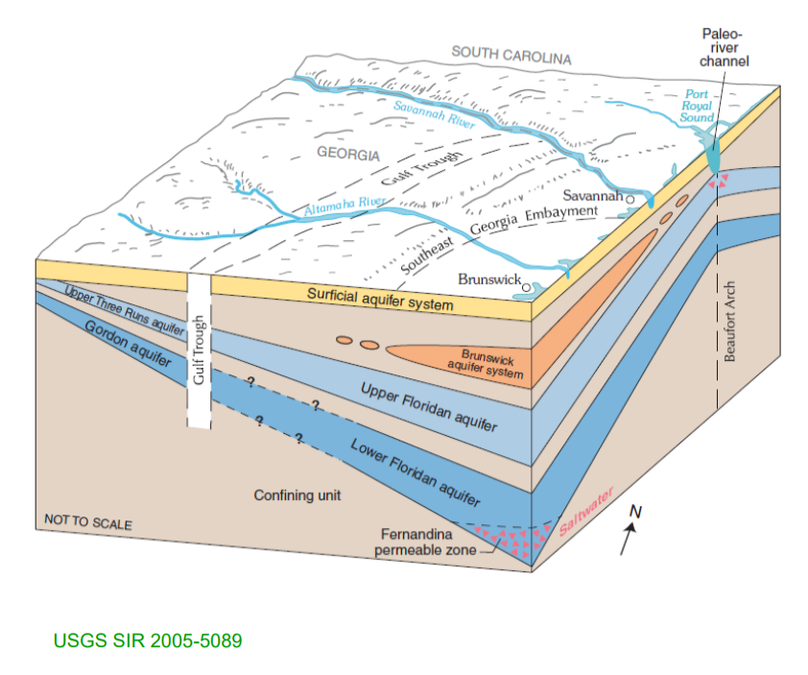
RICHMOND HILL – As state regulators prepare for a major round of coastal water withdrawal permit renewals next year, members of Georgia’s Coastal Permitting Advisory Committee spent hours debating how to balance future growth with long-term protection of the Floridan aquifer, one of the most productive groundwater systems in the world.
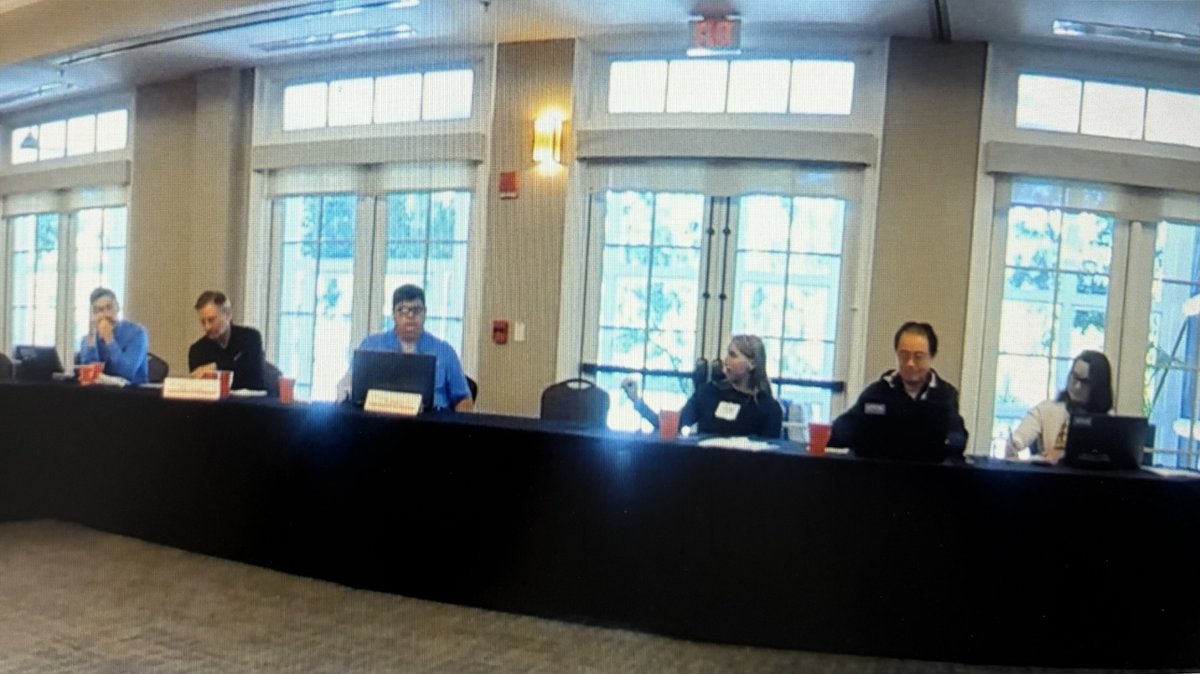
The Coastal Georgia Regional Water Planning Council and the Coastal Permitting Advisory Committee reviewed a series of groundwater modeling scenarios, during a May 18 meeting in Richmond Hill, GA. This was just one in a series of meetings that will shape how the Georgia Environmental Protection Division approaches reissuing water usage permits set to expire in December 2027. The discussion reflected a changing landscape for water management along the coast, where the expansion of surface water infrastructure and the closure of major industrial users are reshaping water availability.
“The coastal area cannot rely on groundwater alone,” Christine Voudy, an assistant state geologist with the Georgia EPD, said to the committee. “It is both surface water and groundwater, and it’s going to have to be that way moving forward.”
Water withdrawal permits in Chatham, Effingham, Liberty and Bryan are set to expire at the end of 2027. The Coastal Georgia Regional Water Planning Council has been meeting since early December to develop a strategy for the reissuance of permits. Policy recommendations are planned to be finalized by June 2027 and implemented by the following October.
Water supply in Georgia’s southeastern region is in a period of transformation.
In August 2025, International Paper, one of the largest industrial water consumers in the region, announced the closure of two mills, reducing its water withdrawal by about 10 million gallons a day. Construction also began on portions of the $500 million water infrastructure package to allow for the increased use of surface water from the Savannah River. A new surface water treatment plant in Effingham County will provide anywhere from 12 to 23 million gallons of drinking water per day. About 18 miles of waterlines will also take water supply to north Bryan County and the Hyundai Motor Group Metaplant America facility in Ellabell, GA.
Savannah’s I&D Water Treatment Plant will also be upgraded and expanded through the project.
During the May council meeting, council members and EPD officials discussed several potential permitting scenarios, including allowing portions of International Paper’s former groundwater withdrawals to be reallocated for other uses while banking the remainder for aquifer recovery. One proposal would bank 100% of the unused water for the aquifer, while another would split the capacity evenly between future users and resource protection.
Regulators are also examining whether groundwater pumping should remain the same or be reduced in areas where new surface water systems are expected to come online in the next several years.
EPD staff said it may become increasingly difficult for permit holders located near new surface water lines to justify increases in groundwater withdrawals. Voudy said future applicants seeking large groundwater allocations could be asked to explain why surface water is not a feasible alternative.
At the same time, regulators acknowledged that groundwater will remain critical in areas where surface water infrastructure is unavailable or impractical.
Dr. Wei Zang, the water supply program manager at Georgia EPD, emphasized a potential model that would expand pumping more broadly across the region rather than concentrating withdrawals in the Savannah area, where nearly a century of industrial and municipal pumping has lowered aquifer pressure, creating a “cone of depression,” and contributed to saltwater intrusion concerns near Hilton Head Island.
An ongoing Savannah pilot study is examining whether shifting pumping among existing wells — while keeping overall withdrawals relatively stable — could reduce pressure on the aquifer.
Several committee members emphasized that recent conservation gains should not be erased as the state considers reallocating groundwater capacity.
“A lot of the efforts of coastal folks, industries, municipal systems reductions have shown a recovery in the Floridan aquifer,” Voudy said. “I want us to keep in mind that we can run these simulations, but we don’t want to erase all the good work that has been done.”
Others raised concerns about expanding the cone of depression by spreading withdrawals outward. Damon Mullis, executive director of the Ogeechee Riverkeeper, cautioned that broader groundwater impacts could potentially affect wetlands and surface water systems connected to the aquifer.
The committee also debated how to establish the baseline conditions for future modeling runs. One option would use pre-International Paper closure permit limits, while another would rely on actual pumping data reported before the company reduced operations.
Tonya Bonitatibus, the executive director of the Savannah Riverkeeper, raised concerns about potential models not accounting for water withdrawal from four wells in Bryan and Bulloch County that were initially drilled to provide water for the HMGMA plant.
“There’s not a future scenario where EPD doesn’t permit those wells that already exist,” Bonitatibus said. “Why in the world would we not include it?”
EPD staff said Hyundai’s usage of the wells, while permitted in 2025, didn’t begin until early 2026. This usage is set to decrease once the Bryan surface water extension project is completed in 2028 and end completely around 2029-2030 with the completion of Effingham’s surface water treatment plant.
“Bryan and Bulloch county wells … it is a temporary and transient use, which means that including it in the baseline would actually skew the baseline for usage,” one council member said.
Regulators said they hope to narrow the options before bringing updated simulations back to the advisory committee during an August meeting, which will include model results and the beginnings of policy discussion. Information on future meetings can be found at https://waterplanning.georgia.gov/.