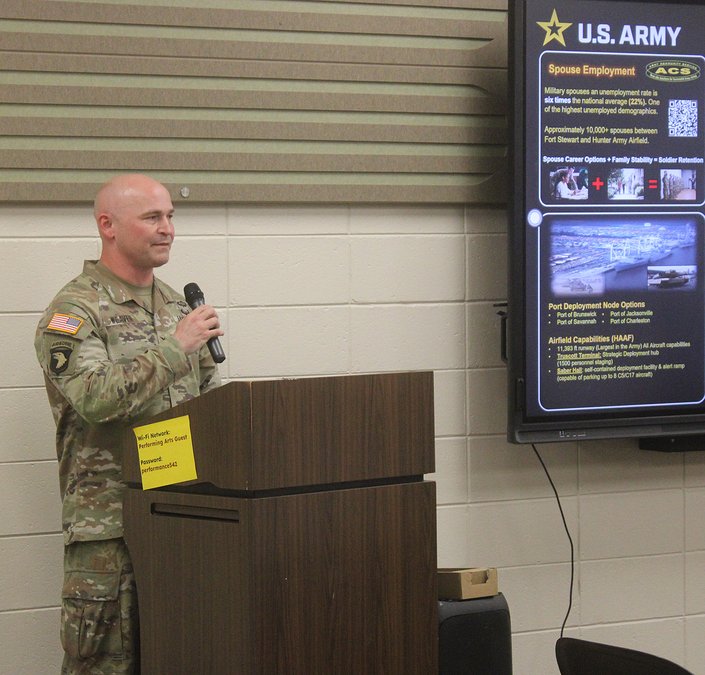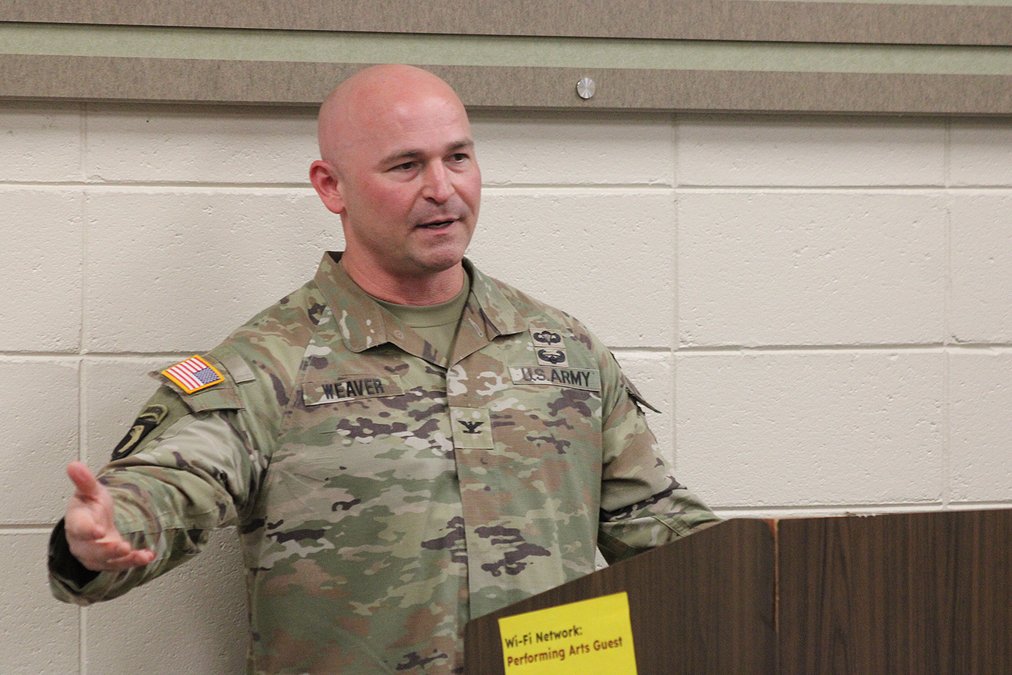
The bedrock of Fort Stewart and the 3rd Infantry Division’s success is the surrounding communities, garrison commander Col. Gabe Weaver said.
Col. Weaver, speaking to the Liberty County Chamber of Commerce Progress Through People luncheon, said true readiness also starts at home.
“A soldier can’t focus on warfighting and the complexities of combat without knowing their families are being taken care of,” he said. “This is why installation support services are so vital. We know our children are learning in excellent schools in Liberty County. We know they’re getting top tier medical care. That lifts a tremendous burden off the shoulders of our warfighters.”
Fort Stewart and Hunter Army Airfield are the premier power projection platforms in the eastern U.S., Col. Weaver proclaimed, and the 3rd ID’s role as the armored fist of the XVIII Airborne Corps means units can be anywhere in the world within 96 hours.
To fulfill that function for the nation, though, requires training.
“Readiness is what you hear at night – you hear the explosions, the gunfire, the helicopters,” Col. Weaver said. “But that readiness doesn’t exist without the right level of support.”
Part of the garrison’s mission is to ensure soldiers are trained, and now, the 3rd ID soldiers are preparing for new kinds of warfare. The Army of the future likely will have fewer rotary-wing aircraft, meaning helicopters, and could turn to what it calls UAS, unmanned aerial system, or drones.
“You’re going to see more drones. We’re not going to have the same equipment,” Col. Weaver said.
The Army of the future will have less expensive and more mission-aligned systems as it looks to save money and build capacity to fight. Earlier this month, the post went through its Black Start exercise, simulating a drone strike on the electrical grid.
The no-notice event meant shutting off the power across the installation, including the schools, housing areas and commissary, with zero warning.
“We learned a lot from that,” Col. Weaver said. “We learned what parts of the grid are more susceptible to an attack like that. We learned the hospital backup generators don’t work all the time.”
The garrison also has to address its aging infrastructure, and such things as sewage, water and gas lines are “deteriorating at a rapid pace,” Col. Weaver lamented, and new lines are extraordinarily expensive.
“Replacing it is a very, very large number,” he said.
The post is taking steps, such as meeting with the state Department of Transportation on upkeep of its roads.
“We can’t train a 21st century armored division on 20th century infrastructure,” Col. Weaver said. “We can’t do it.”
Col. Weaver said there is another matter beyond his control – the cost of bags at the commissary. The Defense Commissary Agency, or DeCA, is charging for bags at base commissaries.
“That’s not the garrison doing that,” Col. Weaver said.
He said the base’s security is more stringent in the wake of the conflict against Iran. But when that action ends, he hopes to return to the previous level of access control, which allowed civilians to get their driver’s licenses scanned and be eligible for six-month passes.
“We will go back to in-lane vetting,” he said.
He also noted the level of interaction with the community after a tour of the Hyundai Metaplant and with the installation’s participation in the Susie King Taylor Park dedication.
“We do not operate in a vacuum,” he said. “We are part of the community and we are very glad to be your partner.”