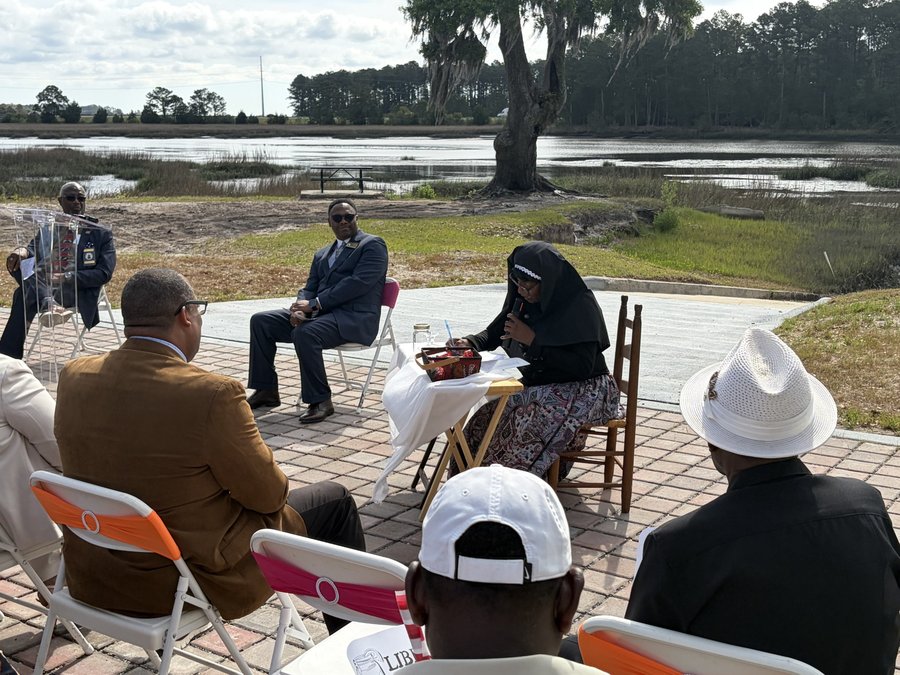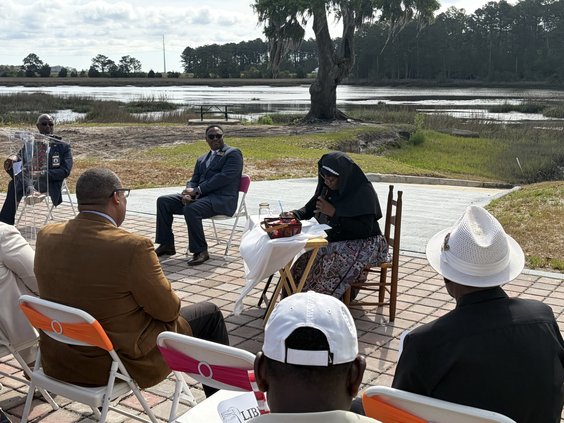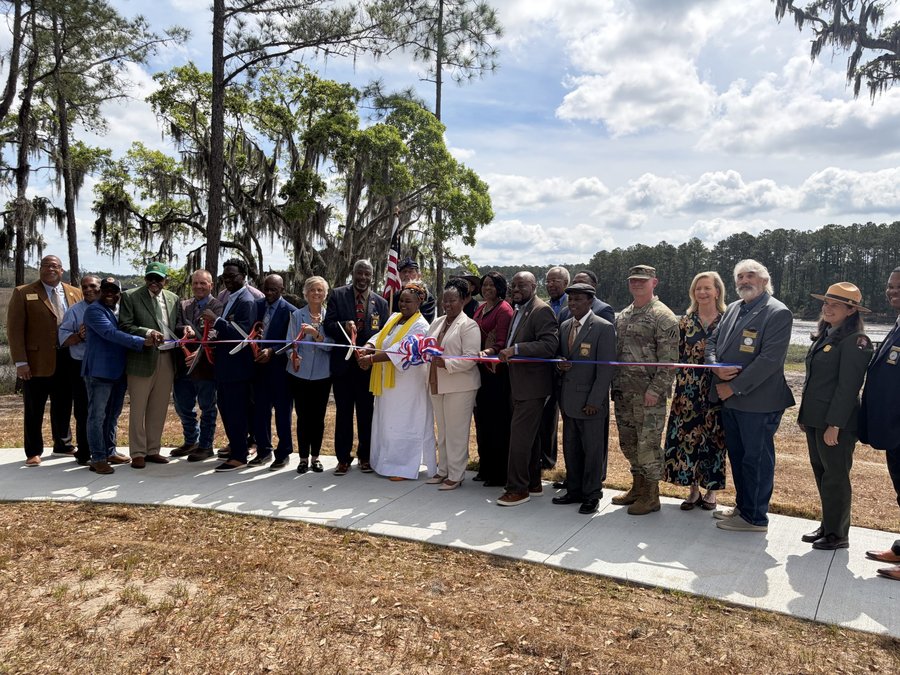
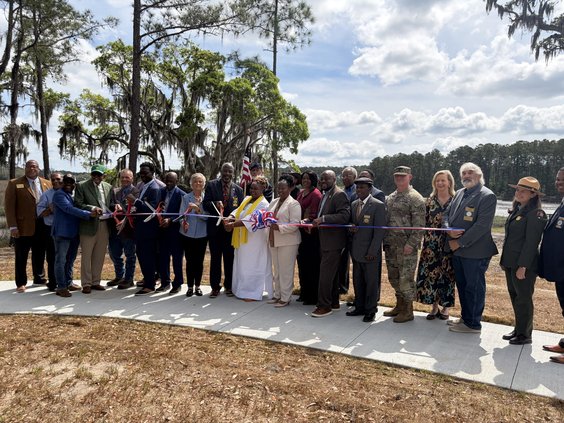
MIDWAY — More than 100 people gathered alongside Jones Creek on Monday for the official ribbon cutting of the Susie King Taylor Freedom Park, a new site dedicated to preserving local history and honoring a significant, yet long-overlooked, Georgia figure.
The morning ceremony brought together community leaders, historians, educators, and residents to celebrate the park’s opening on Isle of Wight – both the birthplace and the site where Susie King Taylor, a Civil War nurse, educator, and author, escaped slavery as a teenager.
April 13 marks the anniversary of the day Taylor escaped enslavement 164 years ago, while April 12 marks the 165th anniversary of the beginning of the American Civil War.
“These two historic moments in our nation have an important common denominator and that is none other than freedom,” Hermina Glass-Hill, Liberty County Historical Society’s president, said. “We are standing here, gathering here in honor and memory of one great American heroine, Susie King Taylor at Susie King Taylor Freedom Park.”
Glass-Hill, also the executive director of the Susie King Taylor Women’s Institute and Ecology Center, has spent more than a decade researching and promoting Taylor’s legacy.
Taylor was born into slavery and grew up between the Isle of Wight and Savannah, where she visited her grandmother and secretly attended school.
One year after the Civil War broke out, Taylor, her uncle and six of her family members climbed into a small boat and sailed away to their freedom. She was just 13 years old. She went on to create a legacy of emphasizing education, resilience and the pursuit of freedom.
Glass-Hill said despite growing up in Georgia, she never learned about Taylor while in school.
“I thought, we can't have another generation not knowing about this important woman in American history, who's right here from Georgia,” she said. “So, I said, ‘how do I go about making her a household name?’”
Glass-Hill’s passion and partnership with local and state leaders helped lead to the creation of the park.
More than $1 million was raised for the revitalization of the Susie King Taylor Freedom Park on Isle of Wright through a public-private partnership, including Liberty County, the Liberty County Historical Society and the Georgia Power Foundation. A combination of COVID-era relief funding (American Rescue Plan Act), SPLOST funds and donations like that of $25,000 from Georgia Power made the project possible.
The park was also designated as a part of the National Underground Railroad Network to Freedom, a National Park Service Program, which “honors, preserves and promotes the history of resistance to enslavement.”
“Liberty County, you have a park that has a national designation, and we ain’t done yet,” Liberty County Commission Chairman Donald Lovette said. “Today we come to Liberty County proud and lift up our native daughter … who makes us so proud.”
Several speakers emphasized the importance of education and ensuring younger generations understand the significance of the site.
Savannah Mayor Van Johnson highlighted Taylor’s accomplishments as the first Black Army nurse of the Civil War and the only African American woman known to publish a memoir of her wartime experiences.
The City of Savannah also has made an effort to celebrate Taylor’s story throughout the city, naming a school, historic square and two ferries after her.
“When you know better, you do better,” Johnson said. “As we have learned more about her extraordinary testimony, we started to be able to do better. We started to say her name. There are many more stories to be told, many more names to be lifted. We have the blueprint. Let's get to work with lifting those names and telling those stories.”
The park project is just in phase 1. Project engineers have transformed the beloved, but dilapidated, community spot in Midway into a clean, paved area with a park and benches to enjoy nature.
Still to come are additional nature walking paths, an amphitheater, a dock for fishing or kayaking and a statue of Taylor, with a hand up waving, “lighting the way to freedom.”
Yanis Medina, director of Susie King Taylor Community School, said the park will give young people a tangible connection to history.
“This park will serve as a living classroom, a place where history is not just learned but felt, where they can walk in the footsteps of someone who changed the world through quiet strength and unwavering purpose,” Medina said.
Under the same mossy trees and alongside the same muddy creek that was once home to enslaved plantation workers, attendees said they felt their presence among them – that Taylor’s spirit had joined them.
Glass-Hill said the fabric of the U.S. is woven by countless micro-narratives like Taylor’s.
“There is an African-American saying that goes, ‘As long as we call their names, they will live forever,’” Glass-Hill said.