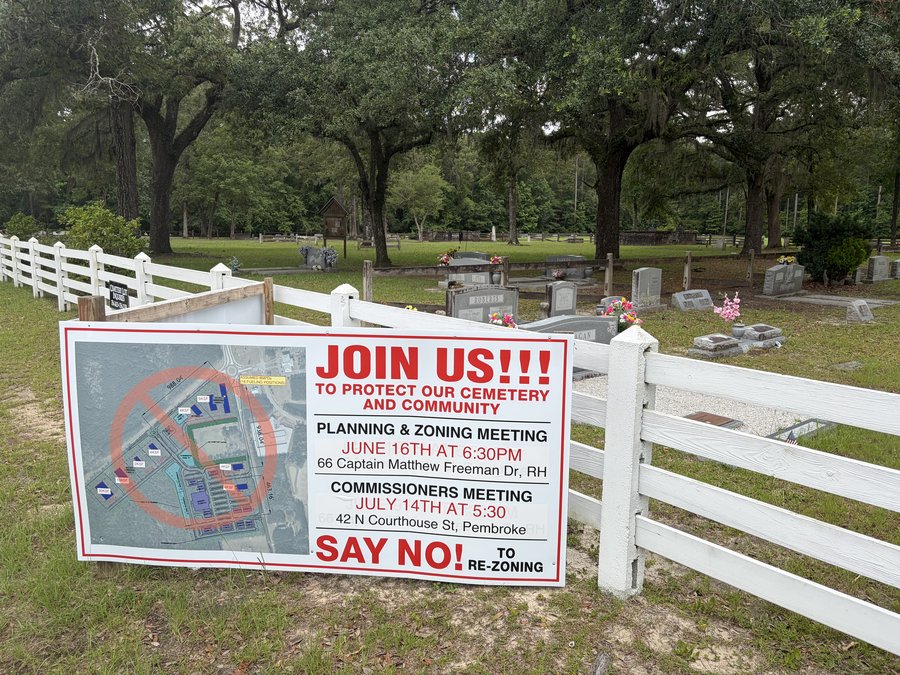
RICHMOND HILL – Bryan County residents packed a Richmond Hill Planning and Zoning meeting Tuesday night to voice opposition to a proposed commercial rezoning near the historic Burnt Church Cemetery.
The request involves approximately 38.86 acres at the corner of Highway 144 and Belfast Keller Road. The property is currently zoned A5 Agricultural. The applicant is seeking B2 General Commercial zoning, a designation that could allow uses such as retail stores, medical offices, restaurants, banks, fuel sales and other large-scale commercial development.
The request by Bouhan Falligant, a Savannah law firm, on behalf of The Cape Group, a real estate development company, was originally heard by the Bryan County Planning and Zoning Commission in May but was deferred to allow additional public input in Richmond Hill.
Commissioners voted to approve a one-month deferral requested by the applicant.
Residents still used the hearing to make their objections clear. More than 10 public commenters raised concerns about traffic, stormwater runoff, noise, environmental impacts and what many described as the accelerating loss of the community’s rural character.
Central to the concerns is the property’s proximity to the Burnt Church Cemetery, one of Richmond Hill’s oldest cemeteries. This cemetery was established in 1830 alongside the Bryan Neck Presbyterian Church, the oldest organized congregation in Bryan County. The church burned in 1882, but the cemetery remains.
Some of the county’s most prominent early families, including the Clay, McAllister and Maxwell families, are buried at the cemetery, which is still active today.
“This project threatens the integrity, quiet reverence and deep historical value of the sacred community landmark,” Tamara Bender, a Bryan County resident, said. “Commercial use would introduce disruptions that cannot be mitigated.”
Phil Corbin, the facilities leader at Richmond Hill Presbyterian Church, said the cemetery is significant to his church’s congregation.
“Just about everybody here has a family member out there,” he said. “We have a lot of people that own plots. I own a plot down there.”
Corbin, who represented his church during the meeting, said his main concern about nearby commercial development is groundwater conditions and the potential for flooding. He said grave sites sometimes require pumping after heavy rains. He questioned whether extensive site grading and stormwater retention ponds could alter drainage patterns and increase flooding risks near the cemetery.
Traffic also emerged as a significant concern.
Residents repeatedly pointed to congestion around the roundabout connecting Highway 144, Belfast Keller Road and Belfast River Road, describing lengthy backups during morning and evening commutes.
Karen Hewitt said the area already struggles to accommodate traffic generated by nearby subdivisions. While a portion of the road was expanded to four lanes about five years ago, the stretch of road shrinks back down to two lanes close to the proposed area of development.
Traffic Impact Assessments estimated the commercial development could generate nearly 14,900 new trips daily, including almost 500 trips during peak hours.
“We cannot sustain in that area with that roundabout the amount of traffic that would come,” Hewitt said.
Amy Mitchell, a Bryan County resident, compared entering the same roundabout to “playing Frogger.”
She said B-2 zoning, which provides for “large county-wide and regional businesses,” is inappropriate for the area. She pointed to the potential for B-1 Neighborhood Commercial zoning, which provides for small-scale stores that demands “design use, scale, and traffic generation of businesses should be compatible with character and needs of the nearby neighborhoods they serve.”
“Frankly, I think it would be incredibly irresponsible to allow B2 zoning for this property,” Mitchell said. “I would prefer that it stay A5. If you have to rezone it, B1.”
Buckhead North resident Ashley Anderson shared a personal connection to the cemetery with commissioners. It’s the site where her son is buried.
“I probably spend more time there than most people in this room,” she said. “It’s a beautiful place and I think it’s very important to protect it for those people that are grieving their loved ones.”
Ben Anderson, her husband, warned that unchecked growth could push Bryan County down the same path as rapidly developing neighboring communities.
“We moved out here for solitude, for nature … for green space,” he said. “The growth has to temper the pace. One of your largest developers, Heartwood … they want to do it the right way, leave green space. So, we want to make sure that everybody has that focus and that mindset to make sure they're coming into our community with our values, our vision. “
Madeleine Blair, an associate attorney in Bouhan Falligant’s firm, told commissioners the developer is listening to community feedback and intends to continue discussions before returning next month.
She said project and county engineers are equipped to handle draining issues and flooding concerns. She also said estimates in the traffic impact assessment are the highest possible estimates.
“This is the first step in a very long development process with quite a bit of county oversight,” Blair said. “What the community is saying means something to us.”
The rezoning request will return to the Planning and Zoning Commission during its July 21 meeting in Pembroke, GA.