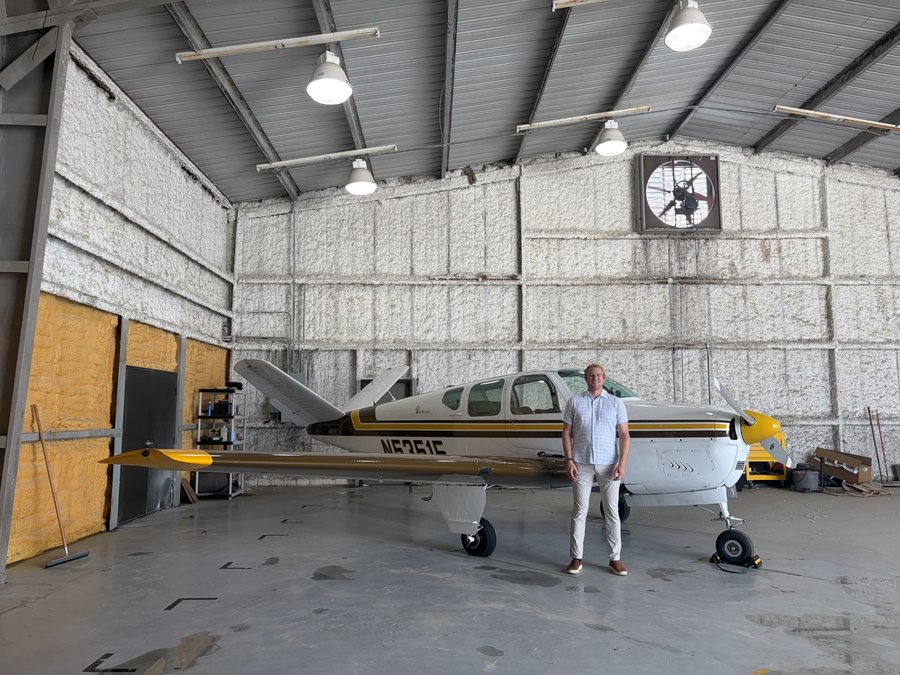
SOUTHEAST GEORGIA – For most of the region’s airports, growth plans are outlined with industrial expansion in mind, but underneath the booming industry, lies a significant gap in infrastructure for the region’s general aviation.
As airports expand to accommodate industrial growth, they are also grappling with lengthy waitlists for private aircraft storage. Bryan County leaders are weighing whether a new airport could help meet that demand.
General aviation encompasses all civilian flying that doesn’t fall under scheduled airline services or military operations. It includes personal and recreational flying, corporate travel, flight training and more.
Regional airports have plans to add new hangars, but in most cases, waitlists outnumber the planned additions. Take for example, the MidCoast Regional Airport in Liberty County, which added 24 hangar spaces to its facility in 2022 and plans to add 24 more in a future expansion project.
“At the time they were being constructed, all the hangars were already taken,” Joey Brown, the former Liberty County Administrator and airport expansion project manager, said. “The hotel was full before it was finished. Now, there’s another waiting list.”
The region’s private pilots are pushing for more hangar space and better general aviation infrastructure in general. One of the arguments from the Richmond Hill-Bryan County Airport Authority is that an airport in Bryan County could help meet that need, but critics of the proposal are skeptical about air traffic safety and the cost to build an airport vs. future profit.
Does southeast Georgia need another airport, and what could cost, income and other challenges look like?
A regional system under pressure
Whether an airport is feasible in Bryan County will depend largely on the findings of the Georgia Department of Transportation's Southeast Georgia Regional Aviation System Plan, an ongoing study examining the operational capacity and future needs of the region's 13 airports.
The Richmond Hill-Bryan County Airport Authority is awaiting feedback from GDOT on whether an airport in the county is needed, depending on the future capacity of surrounding airports.
The closest public-use airport to the proposed Richmond Hill Airport site is the region’s most significant – Savannah/Hilton Head International Airport.
This airport is in the middle of a $300–$400 million capital improvement program, which Executive Director of the Savannah/Hilton Head Airport Commission Greg Kelly said is largely aimed at meeting rising passenger and cargo demand.
But as commercial aviation expands, some pilots worry general aviation is being squeezed.
A hangar shortage A 2023 GDOT study found 1,405 verified aircraft owners seeking hangar storage at Georgia airports, including hundreds of prospective aircraft owners and people relocating to the state.
Kelly said the airport is committed to adding additional infrastructure for the aviation community. A plan to add 30 to 40 additional hangar spaces for general aviation is under development. He said the airport also recently reclaimed a large hangar previously leased to Gulfstream for general aviation use. The airport currently houses 150 general aviation airplanes on site, with a waitlist of about 20.
“We should be able to accommodate the backlog,” Kelly said. “As the demand grows, there’s capacity being added here in Savannah, and we’re prepared to meet the demand moving forward.”
At Statesboro-Bulloch County Airport, Airport Manager Kathy Boykin oversees roughly 70 to 75 hangars, including 10 T-hangars that are currently under construction. The airport has approximately 75 names on its waiting list.
In Claxton, Airport Manager Vernon Owens says demand routinely exceeds supply.
"We could probably fill 10 new hangars tomorrow," Owens said.
Claxton-Evans County Airport currently has 22 hangars housing 22 aircraft and plans to build 10 more.
Both Boykin and Owens said they receive calls about hangar space on a weekly basis.
A need for better regional general aviation infrastructure
Despite Savannah’s plan to increase general aviation capacity, some private aircraft owners feel choked by the expansive commercial development.
Ted Meyer, a private aircraft owner and operator of Roost Aerostorage, a hangar facility at the Savannah/Hilton Head Airport, started the LLC after expansion at the airport pushed him from an old hangar space.
“I got a certified letter in the mail from the airport that said ‘we’re going to redevelop this area, and your lease is going to be canceled,’” Meyer said. “Myself and another number of airplane owners were like ‘what are we going to do?’ There was nowhere else to go at that point.”
The current hangar, which he operates Roost Aerospace out of, now holds his own airplane and five others. He has six on the waitlist to get in. However, he said despite the Airport Commission being good partners, he still worries about how much longer he’ll be able to use the space.
Just about 50 feet away from the hangar opening where he drives his plane out to the runway, concrete is being poured for one of the major expansion projects.
Meyer said he was surprised by the region’s limited general aviation infrastructure compared with nearby markets such as Charleston, SC, and Jacksonville, FL. He said it’s rare for a region’s main general aviation hub to be at the primary commercial airport.
“There isn't that much for people to actually get involved in actually flying and owning an airplane,” he said. “We have just this one airport for all of Savannah that has to cover every use case. You’ve got big airplane manufacturers here, the airlines, the military… all these other things that go on out here. Then, there’s whatever is left over for the other folks that own aircraft.”
Meyer said it’s a missed opportunity for the region. As co-chair of the Savannah Area Aviation Association, he said the lack of infrastructure makes it hard to build a general aviation community. Better facilities could mean more opportunities for flight schools/training programs and more affordable and accessible ways for newcomers, especially youth, to get into aviation.
“We really need more aviation infrastructure in the area,” he said. “I don’t necessarily know if that means another airport per se or using the airport that we do have more efficiently.”
Aviation community conflicted on need for new airport
The proposed Richmond Hill-Bryan County Airport would be built on 300 acres and include a 6,700-foot runway, pad sites for aircraft tie-downs, 14 large hangars and 64 T-hangars. The airport would support private and corporate flights, flight training programs and emergency operations. It would be managed by the Richmond Hill-Bryan County Airport Authority.
The estimated cost is $183 million with the project primarily using federal grants from the Federal Aviation Administration’s Airport Improvement Program and Airport Infrastructure Grants. These require a 5% match provided by the Airport Authority. The Airport Authority says most of this sum, about $9.2 million, will be paid by revenue bonds – loans secured by future airport revenues, like hangar rent and fuel sales.
Boykin said money generated from hangar rent and fuel sales is what is used to operate the airport. A 2020 GDOT economic impact report estimated the airport-supported annual state and local sales and income tax revenues to be $370,020.
However, Boykin said FAA funding makes larger improvement projects possible for most of the region’s airports. At the Statesboro-Bulloch Airport, a partnership with a local private business is paying for the addition of two new corporate hangars.
Owens said in Claxton, money generated from hangar space and fuel sales don’t come close to paying for larger-scale projects. He approximated the airport’s annual income to be about $60,000.
Across the region, monthly hangar rent can be anywhere from $150 a month (at small airports like Claxton-Evans) to a couple thousand dollars at larger, newer facilities like those at Savannah/Hilton Head.
A mixture of state grants and SPLOST funds paid for a new building for offices, conference rooms and a future space for flight school at the Claxton-Evans as well as a 2019 project to construct 10 additional hangars at the space, which cost more than $1 million.
“For a little airport, you don’t generate much,” he said. “It’s a struggle for airports to maintain that kind of stuff.”
For general maintenance, like cutting the airport property’s grass, the airport gets help from Evans County. In Bryan County, the county commission voted to retract any political or financial support for an airport project in December. The city of Richmond Hill recently voted to leave a potential line of support open if the Richmond Hill-Bryan County Airport Authority were to bring forward a proposal.
Owens said he was surprised to hear that the FAA or GDOT would consider putting an airport in Richmond Hill because of the proximity to Savannah’s airport and Liberty County’s MidCoast Regional Airport.
“Air traffic’s already heavy down there,” he said.
Still, he understands the appeal of having an airport to support a county’s economy. In Claxton and Evans County, Owens said the airport has a significant economic impact, supporting some of the county’s main industries like agriculture and Claxton Poultry, which employs nearly 2,000 people.
Kelly, with the Savannah/Hilton Head Airport said he could see a need for another airport in the region in the future to meet growth demands.
“But, there’s a lot of better things to meet the needs of the general aviation community that the state could spend their money on than an additional airport,” he said. “We’ve got to look at investing in some of the existing infrastructure we have first.”