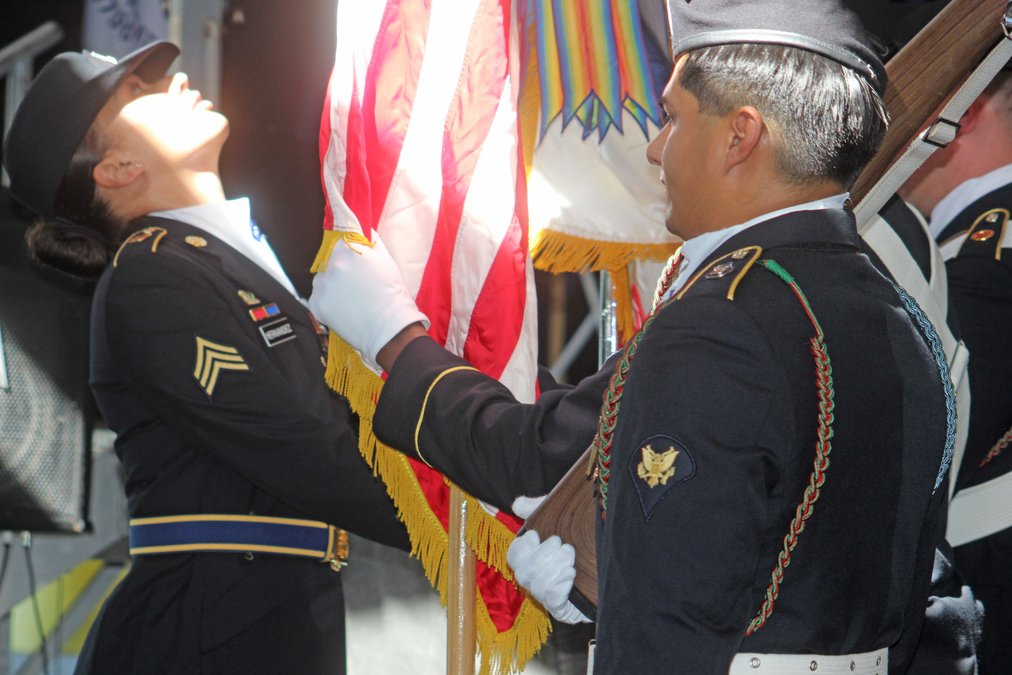
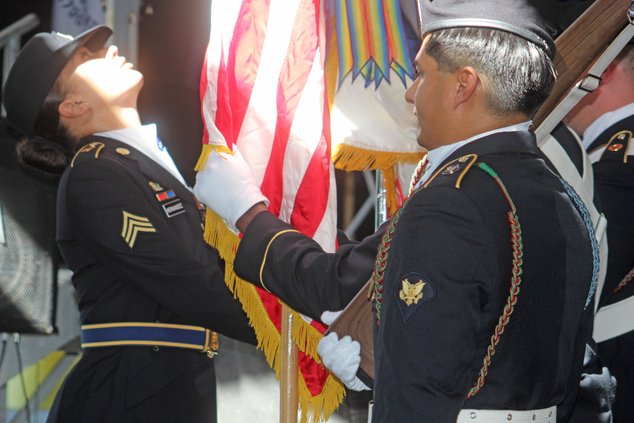
Memories usually tend to fade after 21 years, but for many it’s easy to recall where they were and what they were doing Sept. 11, 2001.
Bryan County Fire and Emergency Services Battalion Chief Lee Newton was an Army tanker stationed at Camp Casey in South Korea when he first saw news of the Sept. 11 terrorist attacks on the World Trade Center and Pentagon.
His recalled his first reaction was disbelief.
“It was at night because of the time difference,” Newton said Sunday while attending Bethel Baptist Church’s 9/11 service at J.F. Gregory Park in Richmond Hill. “We were were sitting in the day room watching TV and the news came on. We were like, ‘nah,’ that didn’t just happen. Then it was ‘yeah, it happened.’ We started knocking on doors, getting everyone out to the day room, and we went on alert.”
Bryan County Family Connection Director Wendy Futch was a student at Georgia Southern University in Statesboro. She was up early that day, working at the school’s welcome center when a call came from her supervisor telling them to turn on the welcome center TV because an airplane had just hit one of the WTC towers. “So we turned the TV on and were trying to understand what was going on, then we saw the second one hit,” Futch said Monday while at a lunch for local first responders provided by Flanders Powell Funeral Home in remembrance of 9/11. “I think being college students, we really didn’t really know what was going on, and terrorism was not a part of my life at that time. I didn’t watch the news, it just wasn’t part of my world.”
Futch recalled phone calls from parents and friends, “everyone checking on everyone to make sure they were OK.”
The uncertainty surrounding what had just happened – and what followed – was frightening, she said.
“I just felt like my world was changing,” she said. “I didn’t know why.”
Congressman Buddy Carter, R-1, was serving as mayor of Pooler. A pharmacist, he was working in his pharmacy when he got news of what had happened.
“I remember the reaction of my staff and our customers, how everyone was so concerned,” Carter said Sunday at J.F. Gregory Park. “Those terrorists wanted to instill fear, and to a certain extent they did, because none of us really knew or recognized at the time how mammoth of an experience this was.”
An immediate need was to do something, anything, he said.
“Everyone wanted to be able to show their patriotism, their hurt, their support,” Carter said. “I remember my staff that afternoon asking ‘what can we do,’ they were saying ‘we have to do something.’ So they got a poster, and all of them wrote on it God Bless America and they signed it. Then they went up front and asked customers to please sign it. It might seem insignificant, but it wasn’t. They wanted to do something, and they did.”
Flanders Powell co-owner Tommy Flanders said he was standing in line at the hardware store when the towers were hit. When he was told what had happened, “it hit me like a brick,” Flanders said.
“It probably took 12 hours to digest what had taken place,” he recalled. “We didn’t know the scope of it at first, and once we knew the scope of it, it was staggering. Shocking.”
It was. There were 2,977 victims of the attacks – not counting the 19 terrorists involved. Of those deaths, 2,753 were at the World Trade Center. Another 184 were at the Pentagon, and 40 died in Pennsylvania when passengers caused Flight 93 to crash into a field rather than let hijackers use the plane as a weapon.
Within months, soldiers began deploying to Kuwait and Afghanistan in the buildup to a war that in some ways has continued to this day as part of the Global War on Terror. It changed the U.S. in ways big and small.
“As a college student, politics and terrorism weren’t in my vocabulary,” Futch said. “At that moment to some extent they became a part of my world.”
It also led Americans to show appreciation for first responders and those in the military “who run toward danger,” as Carter said Sunday, an appreciation many say has to be passed down to future generations.
Newton, who was a firefighter before he enlisted, said 9/11 wasn’t the impetus for his decision to return to the profession after he got out of the Army in 2005.
“I was lucky enough to get back into it when I got out,” he said, but noted that while he’s appreciative of the thanks he gets from the public, that’s not why he does it.
“People are always glad to see us,” he said. “Because they need help, they call us, we show up. But I don’t do it for pats on the back. I do it to help people.”
Flanders, who works with the coroner’s office, said 9/11 changed him. It made him more patriotic, and more thankful for the relationships he has with the community and those who run toward danger.
“It changed the way I view first responders. It’s changed the way I’ve approached the coroner’s office and it’s changed the way we serve families,” he said. “It changed everything. And if it doesn’t, it should. Because every day is precious.”
More PHOTOS below: