I have been through Eatonton, Georgia, many times, on my way to and from visiting friends in Athens.
It’s a small town just north of Milledgeville, on U.S. Highway 441. The old “General Putnam Motel” was still there, on my last visit, some years back, but I think it has long since seen its better days. At first glance, it doesn’t look like much, but it does have a more storied history.
Eatonton is the county seat for Putnam County, and is home to the “Uncle Remus Museum.”
Eatonton was named after William Eaton, an officer and diplomat involved in the First Barbary War; and is considered “Georgia’s dairy capital,” because of the main engine now driving that county’s economy, its dairy herds. Putnam County is named in honor of Israel Putnam, a hero of the French and Indian War and a general in the American Revolutionary War.
The museum is named for the central character in the series of stories written by Joel Chandler Harris, between 1881 and 1907. Harris was then more well-known as the editor of the Atlanta Journal- Constitution newspaper, and was also owner of the house now known as the “Wren’s Nest,” on Atlanta’s west side, now a house museum. (The home with no closets!’) It was initially named after an actual wren’s nest discovered in the mailbox out front; and the name stuck.
I have driven by that little museum in Eatonton, many times, but have not yet taken the time to stop in and see what is there. I should do so one day.
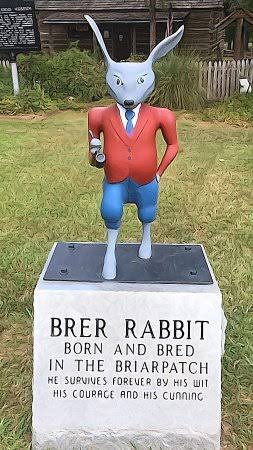
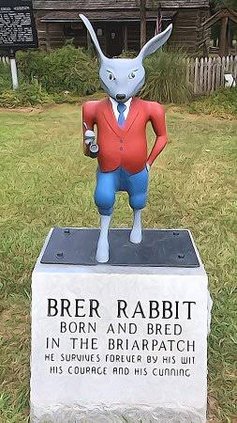
The museum website describes itself thusly: “Visit the Uncle Remus Museum at Turner Park and gather around the fireside for the adventurous tales of Brer Rabbit, and learn about the life and writing of Joel Chandler Harris.
Turner Park, site of the museum, was a part of the original home place of Joseph Sidney Turner, the “Little Boy” in the tales of Uncle Remus. The museum is a log cabin made from two original Putnam County slave cabins.
The buildings are similar to the one occupied by Uncle Remus, the lovable character made famous by Mr. Harris. Shadow boxes containing delicate wood carvings of “de critters” capture the other world of Uncle Remus. The focal point of the cabin is a large portrait of Uncle Remus and the Little Boy.
The Joseph Addison Turner Library/ Office Wing replicates the lifestyle of Joseph Addison Turner. While working at Turnwold, Turner’s plantation, Harris befriended elderly slaves George Terrell and “Old Herbert” who passed on to him the tales of Brer Rabbit and the other critters in the Briarpatch.”
For those of us who are both “linguists” and “historians,” this little town off the beaten path in rural Georgia is an important stop along the path of Georgia history.
A recent internet search reveals a number of elegant Victorian homes, built during its more prosperous past.
But we should not forget its important contributions to both language and literature, as Joel Frank Harris strove to tell us. In addition to being the “Dairy Capital of Georgia,” which I suspect only those who live in its immediate vicinity, or are involved un that industry, are even aware of.
Georgia has many hidden gems! Both historically and architecturally. If only we know where to look.
Rafe Semmes is a proud graduate of (“the original”) Savannah High School and the University of Georgia. He and his wife are long-time Rotarians, and live in eastern Liberty County with their passel of rescued orphan felines. He writes on a variety of topics, and may be reached at rafe_semmes@ yahoo. com.