PEMBROKE – The Bryan County Planning and Zoning Board voted, 2-1, to recommend denying a request to rezone nearly 39 acres near Burnt Church Cemetery for commercial development, siding with residents who argued the project would threaten the historic cemetery and worsen traffic at what residents call one of Richmond Hill's busiest intersections.
Board member Scott Puffer made the motion to deny the request with Board Member Michael Saporito seconding the request. Board Vice-Chairman Stacy Watson voted against the motion.
The board's recommendation now moves to the Bryan County Board of Commissioners, which will make the final decision at its Aug. 11 meeting.
The request sought to rezone approximately 39 acres at the intersection of Highway 144 and Belfast River Road from A-5 agricultural to B-2 general commercial. The proposal, presented by attorney John Northup on behalf of Cape New Bell LLC and property owner SAP Highway 144 LLC, called for a grocery store-anchored shopping center on about 21 acres, with plans for additional commercial outparcels, including restaurants, a bank and potential medical office space.
The remaining acreage would also be rezoned for future commercial development, though no specific plans have been submitted for that portion.
County planning staff recommended approval of the rezoning with eight conditions, including maintaining a 50-foot undisturbed buffer around Burnt Church Cemetery, requiring updated traffic analyses as development progresses, dedicating future right-of-way for potential roadway improvements and connecting the project to county water and sewer.
Northup objected to several of the traffic-related conditions. He said they were too broad and could require the developer to dedicate an undefined amount of land or bear the entire cost of future roadway improvements triggered years after the project is built.
"We can't agree to those conditions as they're written," Northup said.
He said the proposed commercial center would provide needed services to a rapidly growing residential area that currently lacks nearby retail options.
"There is a lot of residential development in that area, and there's really very little commercial development anywhere in there," Northup said. “You really have to go almost 2.5 miles north to the Publix to get any kind of commercial development.”
Northup also said the development would preserve a 50-foot undisturbed wooded buffer around the cemetery with no roads crossing it, which he said represented an improvement over previous proposals for the site.
Much of the opposition to rezoning the property stems from the historical significance of the neighboring Burnt Church Cemetery, one of Richmond Hill’s oldest cemeteries. This cemetery was established in 1830 alongside the Bryan Neck Presbyterian Church, the oldest organized congregation in Bryan County. The church burned in 1882, but the cemetery remains.
Some of the county’s most prominent early families, including the Clay, McAllister and Maxwell families, are buried at the cemetery, which is still active today.
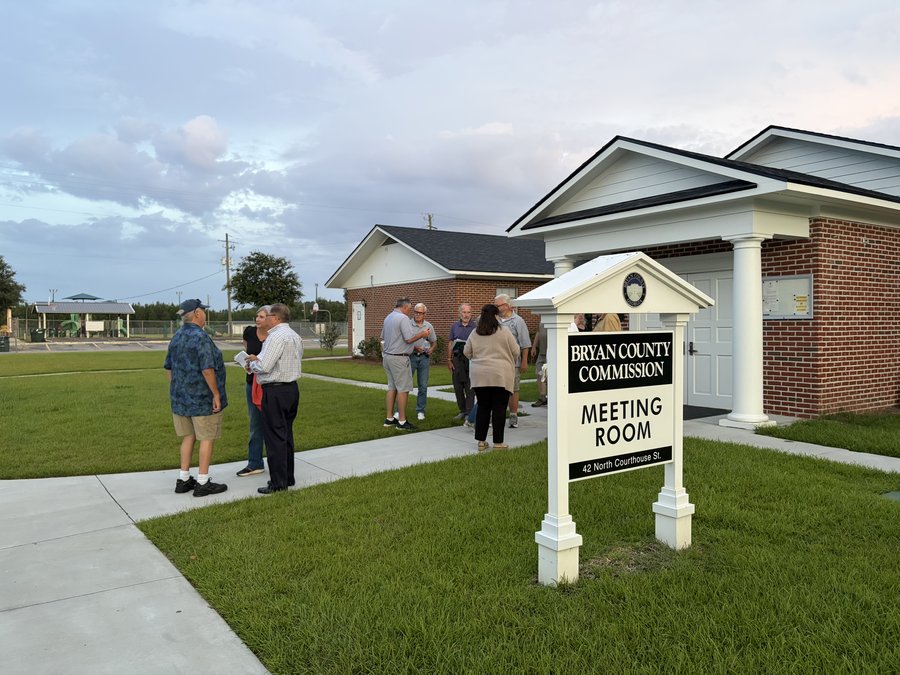
About 10 people representing the Richmond Hill Presbyterian Church traveled to the Pembroke meeting by van to protest the rezoning request.
Phil Corbin, speaking on behalf of the church, said the development would permanently alter the character of the historic cemetery through increased traffic, noise and stormwater runoff.
The church requested a 200-foot vegetated buffer around the cemetery, a 12-foot dirt wall outside of the buffer and restrictions on roadway access near the traffic circle if the project is ultimately approved.
“We strongly disagree with the rezoning of the 16 acres,” he said.
Other representatives of the cemetery said the rezoning discussion has already hurt the church financially, causing thousands of dollars in losses as people are backing out of plots they purchased. The cemetery relies entirely on the sale of burial plots to fund maintenance and preservation efforts.
Board members expressed concerns about both the unknown future development of the remaining acreage and the site's proximity to the cemetery.
Puffer questioned rezoning the entire property when no plans exist for nearly half of it.
"You want us to rezone all this property for somebody we have no idea what they're going to do," Puffer said. “There’s too many unknowns for us to go ahead and make a decision on this whole big piece of property.”
Northup emphasized that any future development would still require additional site plan review and permitting before construction could begin.
Watson acknowledged the property owner's right to seek rezoning while also recognizing uncertainty surrounding future development.
"He has the right to look at his property and say ‘this is what I want to do with my property,’” Watson said. “The scary part to me is that we don’t know what’s proposed here. This is a tough one.”
Board Chair Stephanie Falls said she recognized both private property rights and the county's need for additional commercial services, Falls said public safety and preservation of Bryan County's historic resources remain critical considerations.
"We have failed this county, in my opinion, by not having more stringent historical buffer areas," Falls said. “People love Bryan County because of the history.”
She called on county commissioners and planning and zoning staff to work with people that own and maintain historical properties.
“This is going to come up again and again as our county develops,” Falls said.
Corbin said he is happy with Tuesday’s vote and looks forward to addressing Bryan County Commissioners.
“I think we’re going to come up with the same solution they did here,” he said.
Corbin said he’s also working with other locals in organizing a historical preservation committee.
The planning board's vote is only a recommendation. Bryan County Commissioners will hear this request at their next meeting on Aug. 11.