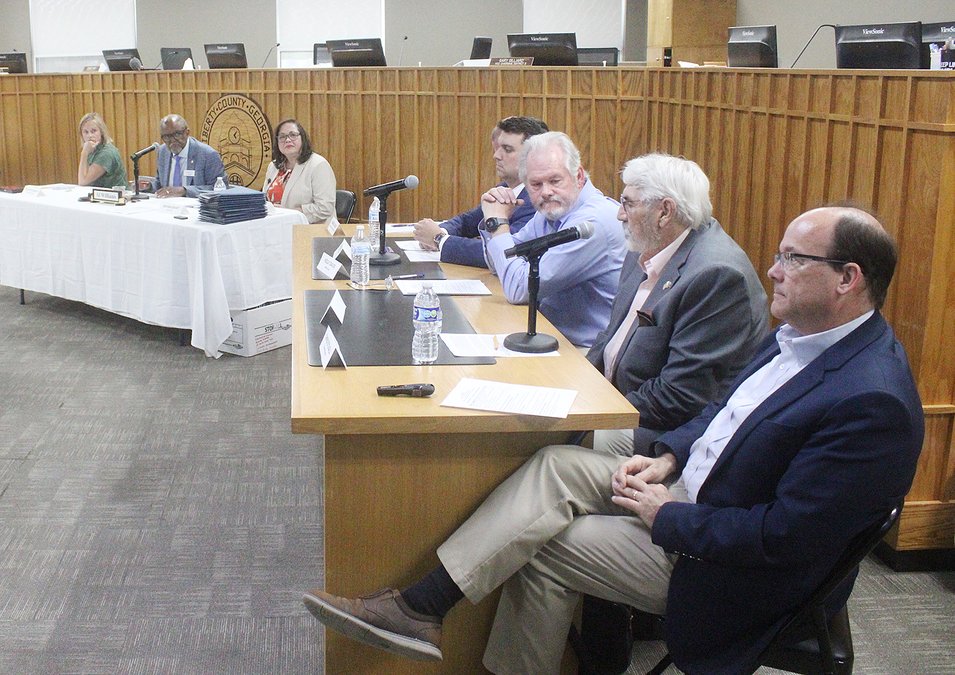
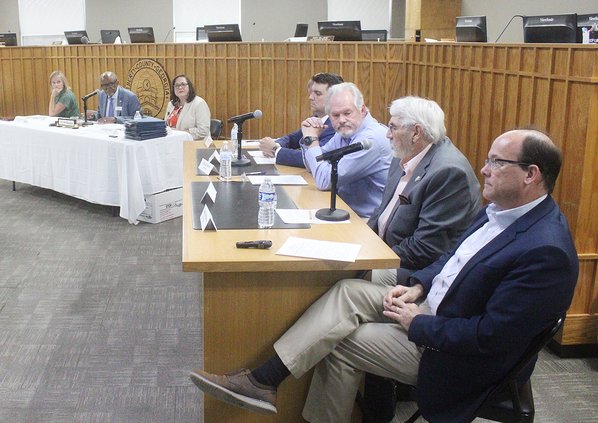
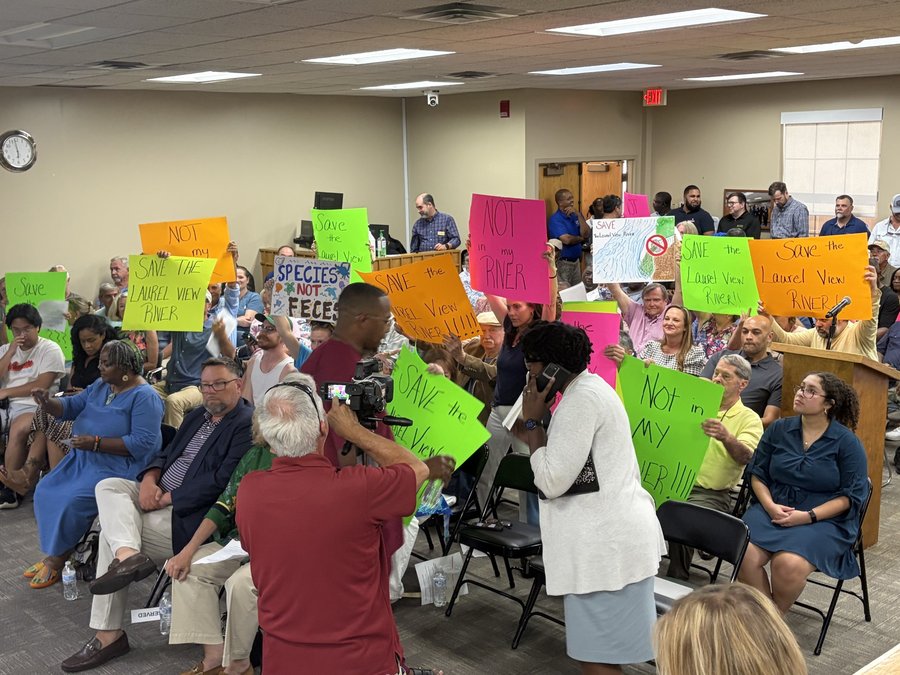
HINESVILLE – A standing-room-only crowd packed a public information meeting Tuesday night as stakeholders talked over a proposed Liberty County wastewater treatment project that could eventually discharge treated effluent water into a coastal river system.
The meeting, hosted by the Liberty County Development Authority (LCDA), focused on plans for a water reclamation facility at Tradeport East near Interstate 95. The facility would use membrane bioreactor (MBR) technology to treat wastewater before reusing as much water as possible and discharging the remainder into a nearby waterway.
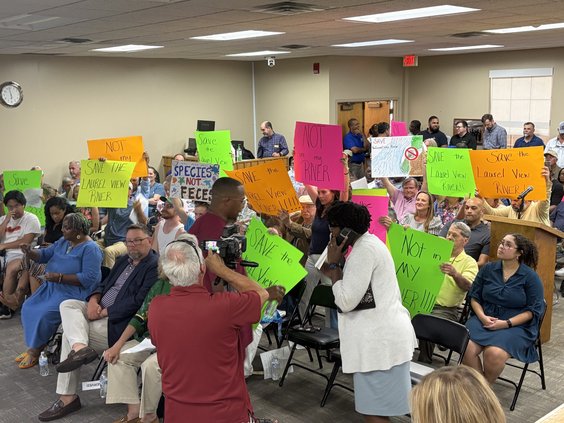
Interest in the project was so high that the meeting room reached capacity, forcing some attendees to remain outside or watch by livestream. Those inside held signs reading “species not feces” and “not in my river.”
The project has generated significant opposition from residents concerned about potential environmental impacts to the Laurel View River, which has been the proposed discharge location.
However, the authority discussed a new project development, Tuesday: It’s now exploring a second possible discharge location in Riceboro’s North Newport River in addition to the previously proposed Laurel View River discharge point.
LCDA CEO Brynn Grant said the North Newport River was not originally considered when planning began nearly two decades ago because of existing industrial discharges in that watershed. However, the closure of International Paper and changes in industrial activity prompted officials to revisit the option.
The authority recently requested a waste load allocation from the Georgia Environmental Protection Division (EPD) for the North Newport River. The review process could take six to nine months before regulators determine whether the site is viable.
If approved, LCDA officials said they would conduct additional environmental studies and engineering evaluations before selecting a discharge location.
“Our analysis of where the discharge point should be will be based on scientific data and what the most environmentally viable discharge point is,” LCDA board member Luke Moses said. “We're going to rely on advice from the EPD and subject matter experts to make that determination. Our decisions are going to be data-driven, not emotion-driven.”
Despite uncertainty about the discharge location, officials said the treatment plant itself would remain at Tradeport East, where infrastructure was originally designed to accommodate a treatment facility. Grant said the site is also one of the county’s highest elevations and sits outside the 500-year floodplain.
Project engineer Chris Stovall said the Laurel View and North Newport rivers are roughly the same distance from the facility, but the final route of any discharge pipeline would depend on future studies involving wetlands, cultural resources, and other environmental considerations.
LCDA officials repeatedly emphasized that water reuse remains a central goal of the project. Reclaimed water could be used for irrigation within Tradeport East and future developments, including the planned Laurel View community, reducing the amount eventually discharged into a river.
The proposed facility would initially treat up to 1 million gallons per day, with officials estimating it could take 20 to 30 years before demand reaches its maximum planned capacity of 3 million gallons per day.
The project comes as southeast Georgia continues to experience rapid growth. Grant said existing wastewater infrastructure is nearing capacity, and Liberty County needs additional treatment options to support future residential, commercial, and industrial development.
“Regional growth is happening,” Grant said. “It demands a modern sewer in Liberty County.”
Grant said a centralized wastewater system is preferable to widespread use of septic systems along the coast, where high water tables, flooding and sea level rise can create challenges.
“There are going to be people moving here and it is not the wisest, best environmental solution to allow for neighborhood development or development with septic systems continuously on our coast,” she said.
During the presentation, LCDA officials defended MBR technology as the most advanced wastewater treatment option currently available and highlighted the extensive monitoring required by state permits. They pointed to Richmond Hill’s Sterling Creek Water Reclamation Facility, which uses the same treatment technology.
“We've visited other plants, and they require strict permitting,” Grant said. “There isn't a day that goes by that the water's not tested.”
Still, many residents remained skeptical.
“Near drinking water is still not good water,” Donald Payseur, a Liberty County resident, said during public comment.
He said he’s concerned about the nitrates, pharmaceuticals, heavy metals and other contaminants that can remain in treated wastewater.
Several speakers also questioned whether studies supporting the project are outdated. The proposal relies heavily on EPD studies completed in 2009 when the reclamation facility was originally proposed.
Grant said EPD officials told LCDA earlier this year that repeating the study today would not produce different results.
Brice Ladson, a Bryan County resident and member of the Save the Laurel View River group, disagreed
“We need a new study,” Ladson said. “We cannot make this decision based upon a 2008 study.”
Fisher Zabarac, a commercial crabber and Isle of Wight resident, raised concerns about potential impacts on seafood harvesting in local waters.
“This will affect my life as well as the rest of all my fellow watermen and residents,” Zabarac said.
Residents living along Jones Creek in Midway, which is connected to the same tidal estuary system as the Laurel View River, also expressed concerns about tidal fluctuations and how they could affect the mixing and movement of treated wastewater.
“You really see a difference when there's a hurricane,” resident David Wasdin said. “What will it look like then? You don't know the unknown.”
Others questioned whether state regulators could be trusted to enforce permit requirements.
Angie Foss, a Bryan County resident, criticized the Environmental Protection Division’s oversight of industrial discharges elsewhere in the region and expressed concern about accountability if violations occur.
“There’s not a lot of faith in the EPD,” Foss said.