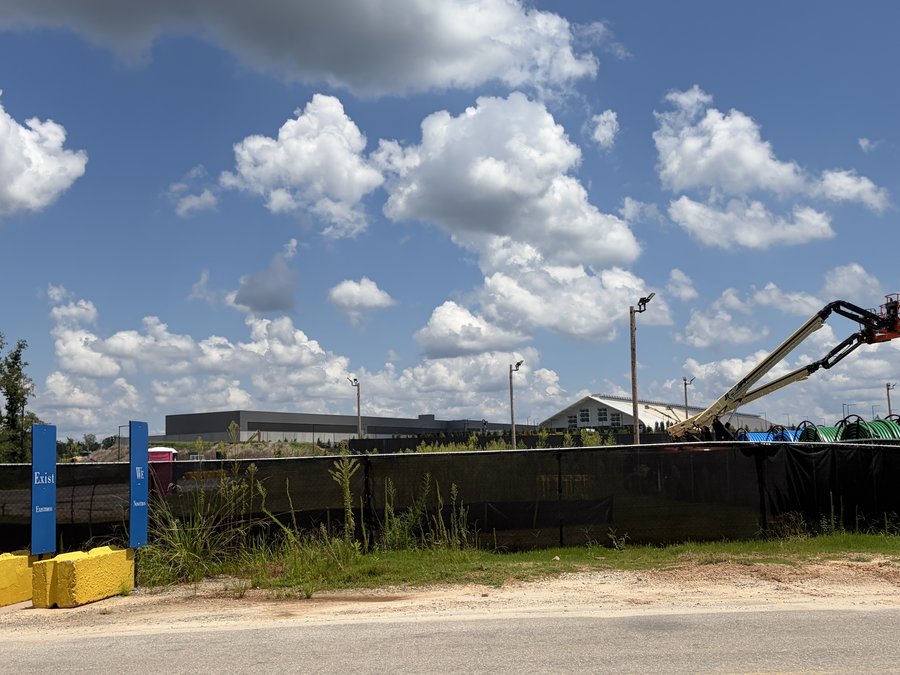
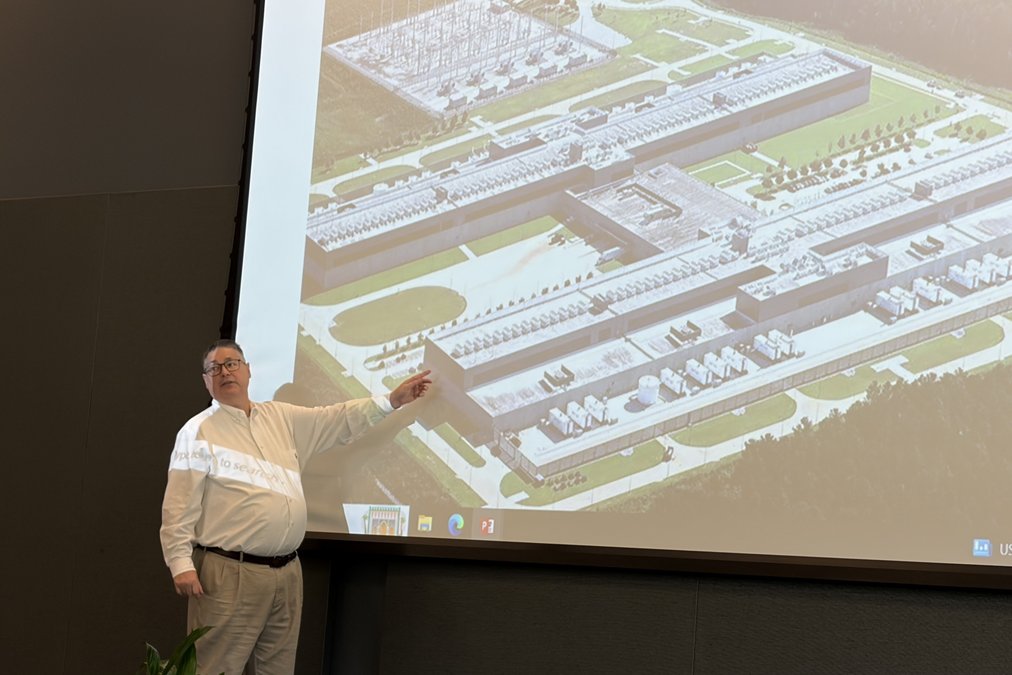
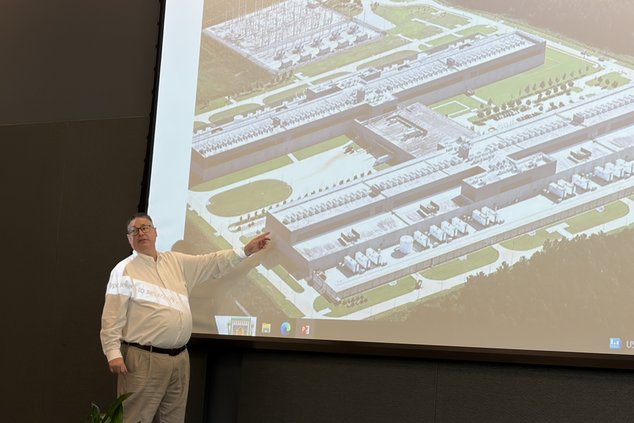
SOCIAL CIRCLE – Just a three-and-a-half-hour drive from Effingham County, where OpenAI recently announced its $20 billion data center project, is Walton County, where data centers from Meta have called home since 2019.
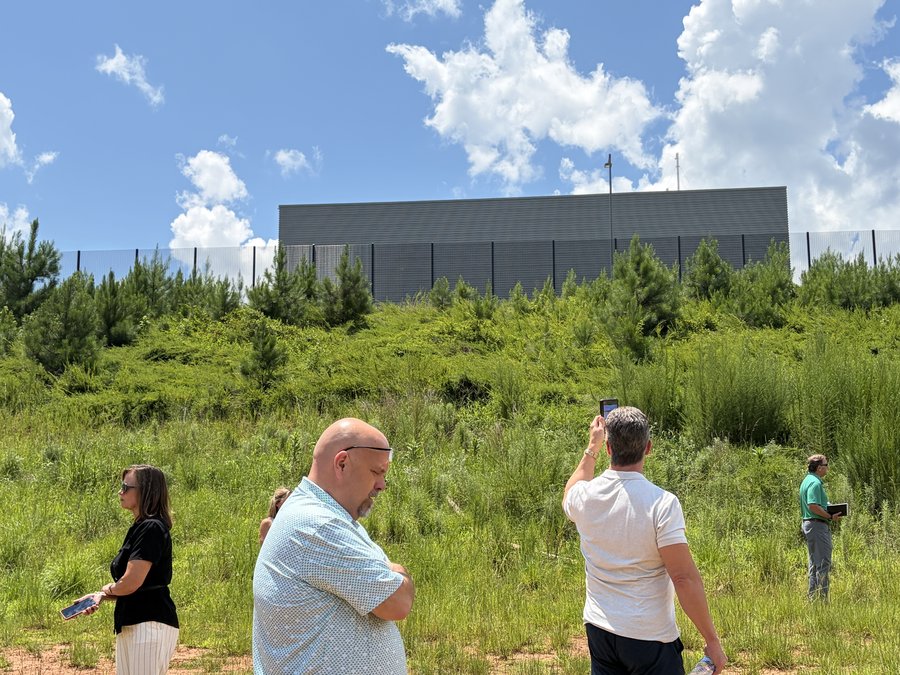
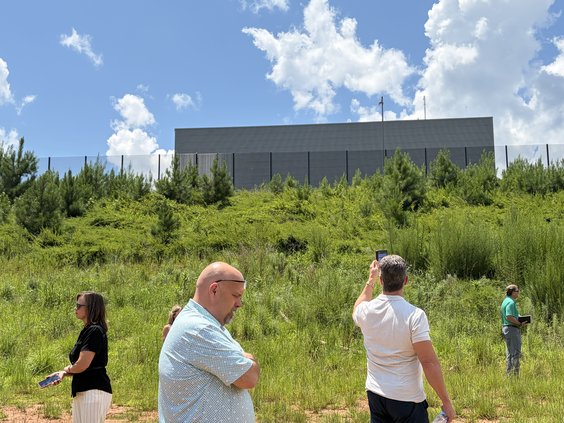
On Wednesday, a group of about 20 Effingham County officials and residents traveled to the Stanton Springs Business Park in Social Circle, which has 13 data center facilities. They heard from economic development leaders and elected officials, asking questions about taxes, water use, energy demands and community impacts. They toured the industrial park and stood outside the data centers, trying to catch a glimpse of what Effingham County’s OpenAI future might look like.
The Development Authority of Walton County organized the visit. Representatives from Effingham County's Board of Commissioners, Industrial Development Authority, Chamber of Commerce and more attended, along with residents who have raised concerns about the OpenAI project. Each participant paid for their own travel.
“We didn’t just want ‘yes-men’ on this trip,” Brandt Herndon, president and CEO of the Effingham County Industrial Development Authority, said.
Walton County Development Authority President and CEO Shane Short said he regularly hosts visitors from across the Southeast interested in learning about the community's data centers.
"We're just sharing our story," Short said. "This has been a very positive experience for us."
This was Short’s first time hosting a group from Effingham County for a data center-specific tour. Effingham County and ECIDA officials had previously visited data center projects in Fayette and Douglas counties, Virginia and Abilene, TX, where a sister OpenAI project is in the works.
Springfield Planning and Zoning Director Erin Phillips said she attended because the city is developing data center regulations, trying to be proactive.
Effingham Health System CEO Dr. Fran Witt asked about occupational hazards associated with data centers. Short said there have been none.
Still, some attendees left believing Walton County's experience differs significantly from what Effingham County may face.
"I did learn a lot about the Meta data center," resident Michelle Johns said. "But that led to a ton more questions about why we were invited to tour this facility. I think the data center that we toured was completely different."
Walton County’s data center story
Walton County began working with Meta, the parent technology company for sites like Facebook and WhatsApp, in 2018, with construction starting the following year. Today, Stanton Springs includes 13 data centers supporting both data storage and artificial intelligence computing.
“We’re looking at adding a tremendous number of more data centers in this particular area between Walton and Newton,” Short said.
The company has invested a total of $94 billion in the Stanton Springs campus, including an additional $10 billion for three new AI data centers.
Since 2022, the company has contributed about $13 million annually through a negotiated payment-in-lieu-of-taxes agreement after Meta initially sought a full tax abatement.
“What I would have done differently today – they would not get the deal that they got,” he said. “They would pay a lot more in taxes.”
Short said the data center campus became a regional anchor and transformed the Interstate 20 corridor into a “digital gold rush” hub, attracting other high-tech tenants.
He said between 10 and 16 new data centers will be announced in the area in 2026 with tax revenues in the $40 million annually.
However, the Stanton Springs Industrial Park’s extensive data center campus hasn’t come without backlash. Residents of the mostly rural community worry about the influx of people new industrial development will bring to the area. They’ve sounded the alarm about light pollution, traffic, noise and low well-water pressure as well as discolored water.
In May, U.S. Rep. Alexandria Ocasio-Cortez held up a jar of muddied water during a U.S. congressional hearing, claiming it was a drinking water sample from residences near to the data center campus. However, Meta has denied any negative impacts to drinking water. On Wednesday, Walton County Chairman David Thompson told Effingham guests that the water was taken from a shallow bored well. He said he hasn’t received any complaints about the data center campus – most residents “don’t even realize it’s there.”
Comparing Meta and OpenAI
Outside the facilities, Effingham County guests listened for operational noise with extended arms, holding phone recorders and decibel readers.
From about 500 feet away, the sounds of crickets and construction overpowered any noise created by the data center. But as the group stepped closer – about 200 feet away – the constant whirring noise from the facility’s cooling fan filters, became clearer.
Johns said she visited the area the night before and could hear the industrial humming from nearby public roads even while her vehicle was running.
Several attendees questioned whether OpenAI's planned campus—which is expected to use substantially more electricity—could produce different impacts.
Meta’s campus is powered by Walton EMC, which uses 100% renewable energy, supported by more than 1,100 megawatts of new solar capacity added to Georgia's grid. It has its own substation and transmission lines leading to the data center, which Meta paid for.
OpenAI has also said it will pay the full infrastructure and electric service costs to serve its facility. It’s contracted to receive up to 3.2 GW of electricity from the Georgia Power Company, where grid expansions to accommodate surging data center demand relies on expanded and new natural gas infrastructure and delayed coal plant retirements. Effingham County’s very own Plant McIntosh gas plant is a part of those expansion efforts.
Both campuses use closed-loop cooling systems. Short said Meta recycles its cooling water instead of continually drawing fresh water and that actual water use has been far below original projections. Industrial water from the facilities is collected, treated at a new reclamation plant and returned to the data centers for reuse, with officials reporting that no cooling water leaves the system. He said cooling systems typically operate only during the hottest months of the year.
Johns said questions remain about how OpenAI will dispose of industrial wastewater. Effingham County Manager Tim Callanan has said that this wastewater will be periodically removed from the closed-loop system and trucked to a wastewater treatment facility; although, Effingham’s current facilities lack the technology to treat this wastewater.
“When we went to the OpenAI open house, I asked several of their representatives where their waste was going … how much waste is going to be produced,” Johns said. “Nobody knew. It was very frustrating.”
She also said the two projects differ because OpenAI's proposed campus would be located near neighborhoods and two elementary schools, while Walton County's industrial park sits farther from residential development and along I-20.
Johns said seeing the Meta campus made her feel discouraged about OpenAI’s future campus.
“If the community does not want something, why can't that be enough? Anyone that I've talked to … the majority of the community does not want this data center and why can't that just be enough for a no?” she said.
Several attendees also took note of Walton County's regulations requiring data centers to obtain special use permits and comply with lighting standards designed to reduce light pollution.
“People are scared they’re going to lose their stars, their ability to sit on their back porch,” one Effingham resident said during the tour. “They’re afraid of losing the way of life that they have.”
Effingham County District 2 Commissioner Roger Burdette said additional public information sessions are planned later this month, and he hopes to organize another tour of data center developments in Fayette County, which he said he believes to be more similar to what Effingham County will have.
Lucille Lannigan is a Growth and Development reporter with Morris Multimedia. Reach her at llannigan@morrisnews.com.