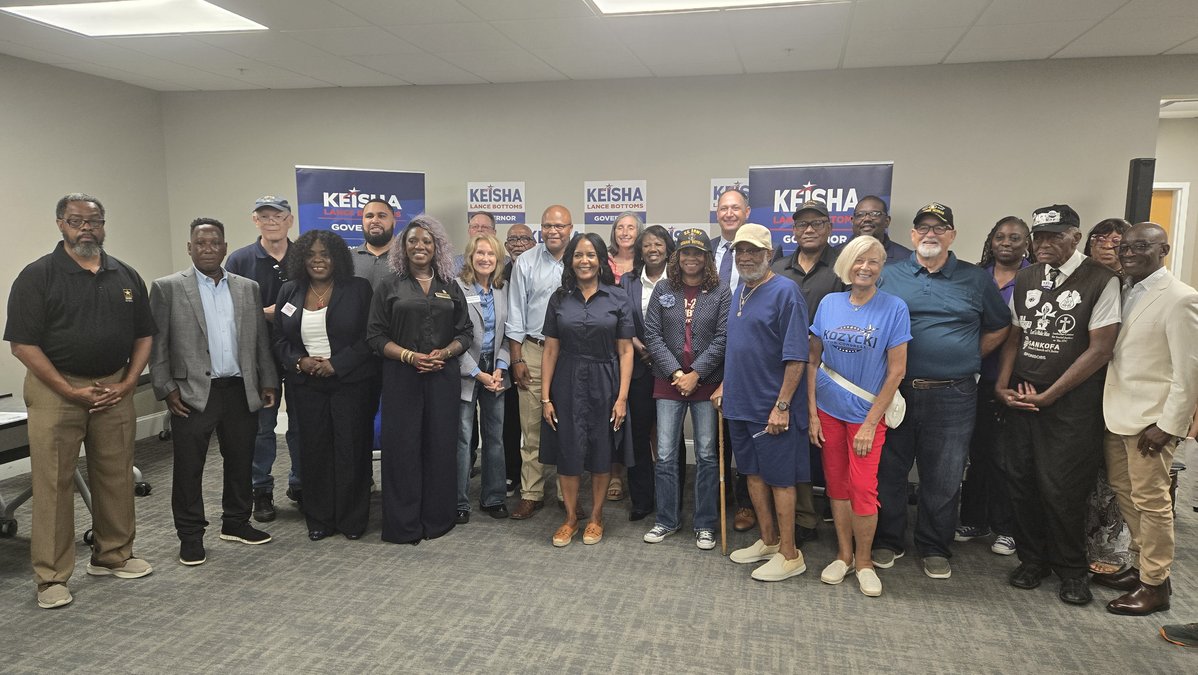
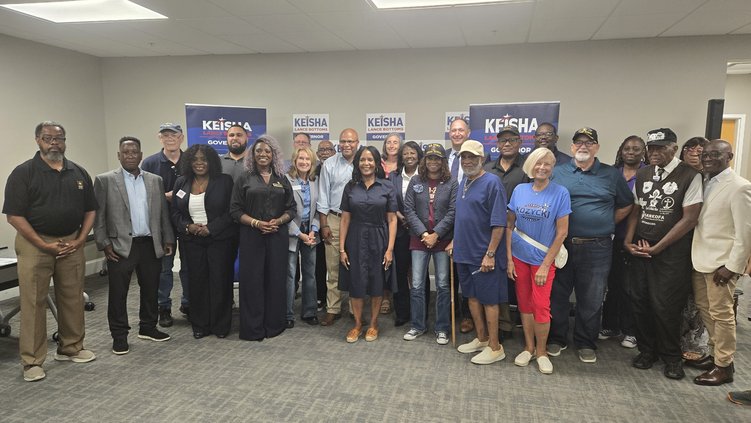
RICHMOND HILL – As part of her three-day campaign tour in South Georgia, gubernatorial candidate Keisha Lance Bottoms (D-GA) made a stop in Richmond Hill Friday to discuss veterans’ issues, with a special focus on veterans’ healthcare needs, right before a scheduled visit to the Democratic Party of Georgia’s state convention in Savannah on Saturday.
She was joined at the roundtable by other statewide Democratic candidates–many of whom are veterans themselves–as well as local veteran community leaders.
“We are gathered to have some really important conversations, and not just for me to talk but most importantly for me to listen,” said Bottoms.
Owing to the presence of Fort Stewart, Bryan County is home to one of the largest veteran populations in the state of Georgia, alongside neighboring Liberty and Effingham counties.
Bottoms’ focus on South Georgia during her campaign tour was appreciated by local veterans in attendance such as Pat Wilver, U.S. Army veteran and former Democratic candidate for Georgia’s 1st Congressional District.
“There’s a lot of criticism that politicians never make it out of Atlanta, so I think the fact that they held this roundtable here in Richmond Hill, that they’re holding the convention here tomorrow [in Savannah] means a lot,” said Wilver.
Guest speakers at the roundtable spoke out on issues such as long wait times at VA hospitals, the need for Medicaid expansion in Georgia and better mental health support and jobs for veterans.
Bottoms has made Medicaid expansion a central part of her campaign, a move that many at the roundtable believe is the right call to help veterans currently without health insurance, particularly in rural counties.
“Since Georgia has not expanded Medicaid, you have almost 400,000 people not covered, and the GREAT (Georgia Rural Enhancement and Transformation of Health) Help program that Georgia had put in place, right now is only covering about 17,000,” said Pam DeLancy, retired U.S. Army Colonel and Democratic nominee for Georgia's 10th Congressional District, a House seat currently held by Rep. Mike Collins who won the Republican Senate primary to face Sen. Jon Ossoff in November.
“Georgia is not a veteran-friendly state,” said Shawn Harris, Democratic candidate for Georgia's 14th Congressional District, to approving applause from the crowd. A retired Brigadier General, Harris described his difficulties with getting his mental health treatments covered by insurance.
“I pull up [to the facility], and the lady says to me, “We don’t take TRICARE anymore,” Harris said.
“This is why I’m getting the hell in this thing called politics. They fixed it, but what goes in my mind is E4 [more junior rank] Harris wouldn’t have any one to call and E4 Harris would have probably been dead.”
“When we talk about mental health, it’s not always [about] the access, it's about those of us that do not get the access and no one knows it,” Harris said.
The issue of jobs came up as well, with speakers citing the link between poor mental health and poor employment outcomes for military veterans entering the civilian workforce.
“Mental health is a barrier to a lot of veterans getting good jobs”, said Nikki Porcher, Democratic nominee for state Labor Commissioner and U.S. Air Force veteran. “There’s a lot of disabled vets who are unable to actually work in the workplace.”
“So when we’re talking about mental health, I don’t want to talk about just staying off the street, but also getting a job and getting a job that we feel valued in. A lot of us are going into the service and we’re not able to transition our service skills into the civilian world”, continued Porcher.
Paul Manley, a Vietnam vet and local builder based in Richmond Hill, said that the trades could be a good option for veterans looking for work after serving.
“There’s a need for highly skilled, trained people for the trades,” said Manley. “And trade unions are willing to train people and pay them if they’re being trained.”
Outreach was cited as a priority as well, with U.S. Army veteran and Bryan County NAACP chairperson Clyde Shepherd citing the veterans’ resource fair hosted in Richmond Hill by the Bryan County NAACP as an example to follow statewide.
Towards the end of the hour-long roundtable, Bottoms touched on her experience as Mayor of Atlanta in helping homeless veterans, with the city often working in conjunction with nonprofits such as the Arthur M. Blank Family Foundation.
“But I know, that is not something that is being replicated in communities across the state,” Bottoms said.
The pressing desire to see better support for Georgia’s veterans and their families was shared throughout the room at Friday’s roundtable, motivating those running for office to drive change if they get elected.
“Right now, there are more young people in the Middle East earning the title of veteran. The reality is that we’re obligated to do something, because there is a whole ‘nother wave that’s coming,” said Harris.