SOUTHEAST GA. – OpenAI’s $20 billion planned data center development in Effingham County may have put southeast Georgia on the data center map.
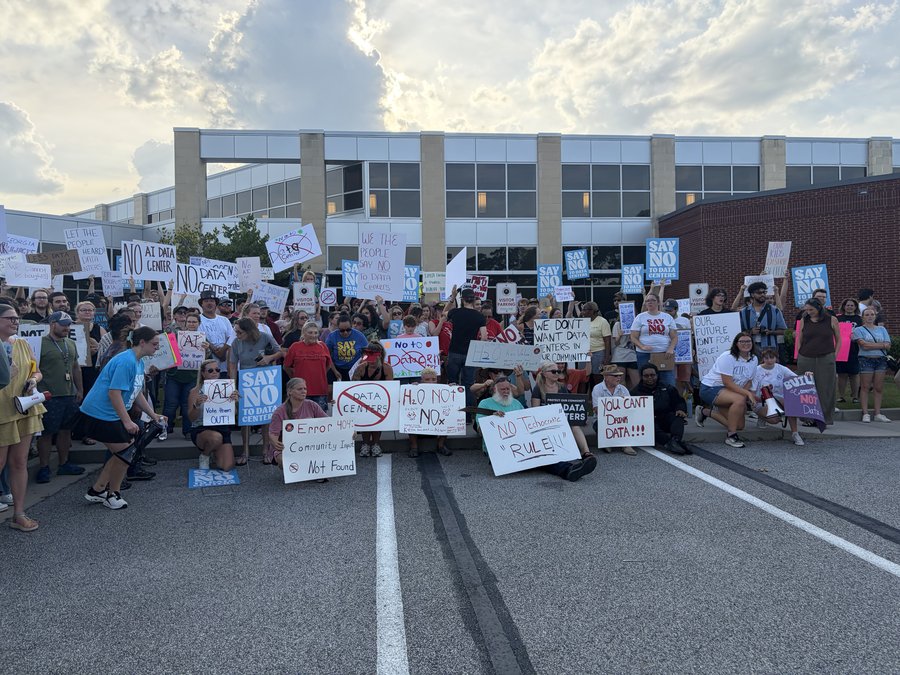
Cities in Bryan, Bulloch, Effingham and Liberty counties are receiving data center development inquiries – some for the first time. A wave of data center moratoriums is now washing over southeast Georgia as local governments scramble to be proactive rather than reactive to the state’s data center boom.
While Georgia’s been a nationwide leader in developing tech facilities for at least a year, southeast Georgian leaders predicted that the region’s water and energy infrastructure would be a barrier to development. Much of southeast Georgia lies in the yellow and red zones, most at risk for saltwater intrusion into the Floridan aquifer. The risk of severe storms and hurricanes along the coast also leaves power grids vulnerable.
However, technology like closed-loop cooling systems, which require less water, and a major Georgia Power infrastructure expansion mean a region that was once seemingly unfit for data centers will now house one of the largest in the country.
OpenAI announced its 1,400-acre Effingham County data center campus in July, which is expected to use 3.2 Gigawatts of electricity at full build-out.
Since then, advocacy has picked up for local officials to establish stronger safeguards to guide their own data center destinies. Some say the region – and Georgia as a whole – need to move beyond a patchwork of local responses and establish clear rules before developers come knocking.
“Data centers are not going away,” David Bennett, Chairman of the Bulloch County Board of Commissioners, which was one of the first counties to establish a data center moratorium, said. “This is something that you’re going to have to regulate and make work within your community. Otherwise, they’re going to take advantage of you.”
Step 1: Moratorium
Community members across coastal Georgia are pushing their elected officials to adopt moratoriums on data center development, regardless of whether they’ve received inquiries or proposals.
They argue it puts a pause on any potential development and gives communities a chance to research and develop ordinances or zoning guidelines.
“You can’t outright ban data centers because of state and federal laws,” Damon Mullis, the Ogeechee Riverkeeper, said to Bulloch County’s Board of Commissioners in April. “But, you can prepare. You can create guidelines, limitations, consequences for noncompliance.”
While Bulloch was the first, Liberty County and the city of Pembroke in Bryan County have since followed suit.
Liberty County Commissioners voted unanimously to adopt a 120-day moratorium, beginning Oct. 15.
The Liberty County Development Authority confirmed it’s received inquiries since Effingham and Wayne County data center projects have been announced; though, none have been presented to its Board for commissioners.
The City of Pembroke adopted a 180-day data center moratorium in the first week of October. Pembroke Mayor Tiffany Ziegler said while the city hasn’t received any inquiries, she wanted to ensure its code addressed data center development clearly.
Ziegler said she personally doesn’t support data centers within Pembroke’s city limits, mainly due to infrastructure limitations and a lack of support from the community.
“At the same time, we need to be careful and precise with the wording of any ordinance,” she wrote. “My priority is clear, specific language that defines what is permitted, what is prohibited, and what requirements apply.”
Bulloch County has even taken its moratorium period a step further, extending it beyond its original 90 days and forming a committee made up of people from the community and nominated by commissioners to provide input as Bulloch County drafts an ordinance for data centers.
The committee held its first meeting in early October. Bennett said the county is willing to extend its data center moratorium beyond the first of the year if extra time is needed to form an ordinance.
“There is no rush,” Bennett said. “The goal is to come out of this with a solid zoning policy that protects the people of the county while also providing some benefit to them.”
Jeffrey Beauvais, the north coast advocate for coastal nonprofit One Hundred Miles, said his organization is encouraging more local governments to formally involve its citizens in the process through opportunities like advisory boards.
“There are a lot of good staff who are doing good work, but it remains sort of behind the scenes,” he said. “I think it gives people a lot more confidence in whatever law a county or city ultimately writes up if they feel they've been meaningfully involved in the process or they know someone who is meaningfully involved.”
Step 2: What’s in an ordinance
Nonprofits like the Ogeechee Riverkeeper created data center ordinance templates for communities to consider.
They encourage communities to require a Special Use Permit for data centers, forcing developers to go through the public process and requiring a public council vote.
This is what Statesboro’s Planning and Zoning team opted to do when it finalized its data center ordinance in June, after nearly a year of researching the tech facilities.
“We were not keen on having a by right allowance for them,” Statesboro Planning and Zoning Director Justin Williams said. “That’s how you end up with a lot of them in your community, and you end up with problems.”
Writing data centers into an ordinance as a permitted use is also how developers and elected officials avoid the public eye, as seen in Effingham County, where OpenAI’s massive project moved forward without a public hearing or any type of vote.
Cities and counties are also being urged to prohibit non-disclosure agreements during the proposal and development process.
Statesboro is now in the middle of a lawsuit over rezoning, which allowed a proposed data center project on Burkhalter Road; however, the city’s data center ordinance has been complimented as one of the strongest in the state.
Water use and noise were among the city’s primary concerns. Developers must submit a water management plan detailing how they will handle water consumption and wastewater, with requirements intended to prevent harmful discharges into the city’s water system, according to the ordinance. It also establishes closed-loop cooling as the baseline for limiting water consumption.
Developers must also provide a sound study documenting existing noise levels before construction. Buffer requirements, including trees and other landscaping, are designed to reduce noise impacts on nearby homes, schools and churches.
The ordinance also caps data center developments at 50 acres and requires a decommissioning plan outlining how facilities will be removed or repurposed when they are no longer needed.
Williams said the rules are intended to prepare Statesboro for a growing industry, not necessarily attract new development. The city had no other known data center proposals, as of Oct. 8.
Williams encouraged other communities to begin drafting regulations early, study existing data centers and learn from municipalities that have already addressed the industry’s challenges.
“Take away the abstract monster that you hear about on social media and visit one,” he said. “Start working toward getting regulations in place before they come knocking at your door.”
“A vulnerable position”
Beauvais said One Hundred Miles has tracked data center development across southeast Georgia for nearly a year.
He said a common way he’s seeing leaders avoid the data center discussion is by claiming its code of ordinances doesn’t have specific language for data centers; therefore, they’re “not allowed.”
“When there’s an undefined use, it’s not outright banned,” Beauvais said. “You don't want to put yourself in the vulnerable position where someone who has some legal creativity could argue, ‘Well, actually, a data center is close enough to this other allowed industrial use so it should be allowed.’”
This is the approach both Richmond Hill and Bryan County have taken.
Local leaders here say the facilities are not permitted under existing zoning rules, limiting developers’ ability to build them without changes to local law.
Bryan County Commission Chairman Carter Infinger said a county moratorium on data centers would be unnecessary because existing rules already prohibit them. Data centers are not identified as a permitted use in the county’s Unified Development Ordinance (UDO), nor is there a comparable use under which one could be approved, according to a September statement from the county’s communications team.
“They’re not allowed, period,” Infinger said. “They can’t ask for a variance to get one.”
Richmond Hill Planning and Zoning Director Brian Crooks said the city’s UDO also prohibits data centers. Crooks said the city does not allow use variances or special use permits to authorize uses not included in its land-use regulations. A text amendment would therefore be required to expressly allow data centers.
However, a potential exception involves the 2013 Belfast Commerce Centre planned unit development district. Its regulations allow certain unclassified or future uses with city approval.
The city already received one inquiry at the beginning of October for a data center at this site.
The Development Authority of Bryan County, which owns the land, shut down this proposal.
Call for broader regional coordination and state regulation
There’s also been a greater call for more state regulation on data centers to help protect Georgia’s 159 counties from harmful development.
The Georgia state legislature adjourned in April 2026 without passing any major data center regulations or repealing state tax breaks, despite 20 prospective bills being introduced.
“So, we currently in our state do not have a law or a policy that provides a regulatory framework or guardrails for data centers in our state,” Public Service Commissioner Alicia Johnson said during a data center panel in Springfield. “It is literally being left up to local economic development authorities, local county commissions, and local city governments … who are not equipped for the conversation.
One state entity trying to prepare communities to confront the data center boom is the Georgia Chamber of Commerce, which launched its Georgia Digital Infrastructure Alliance in July to “educate the public and elected officials about the role of the digital economy.” It also launched a Data Center Ready Community Designation.
The Georgia Chamber has also begun hosting regional data center discussions with elected officials. It met with southeast Georgia leaders, Oct. 20, in a media-free, invite-only meeting.
However, formal discussion has been lacking within southeast Georgia’s regional planning organizations.
The I-16 Joint Development Corridor, which helped recruit the Hyundai Motor Group Metaplant America to the area, hasn’t discussed any regional data center development strategies, according to an emailed statement.
The Coastal Regional Commission of Georgia, which is in the middle of updating its Regional Comprehensive Plan – a blueprint for community growth, land use, transportation, economic development, etc. – hasn’t hosted formal discussions or meetings pertaining to data center development, according to Wincy Poon, the planning and government services director.
At the Coastal Georgia Regional Water Planning Council’s September meeting, which centered around planning for the region’s future groundwater use, a public commenter brought up Effingham’s large data center. There was no further discussion about accounting for this potential type of development in water planning.
“We would like to see a lot more regional planning,” Beauvais said. “That’s difficult obviously, but it’s necessary when we have these regional resources being impacted.”