RICHMOND HILL -- Members of Richmond Hill City Council set the 2026 millage rate during a brief meeting Tuesday night after honoring Dr. Gloria Shearin and the late Billy Albritton, longtime residents whose service helped shape the city for decades.
Shearin, a retired educator who is moving away from the area, spent four decades as a member of the Richmond Hill Garden Club and was a driving force behind a number of the club’s annual activities ranging from the Pumpkin Patch in October to its spring plant sale, Mayor Kristi Cox said.
“She leaves Richmond Hill more beautiful and her garden club stronger than when she found it,” Cox said of Shearin, who was not present at Tuesday’s meeting.
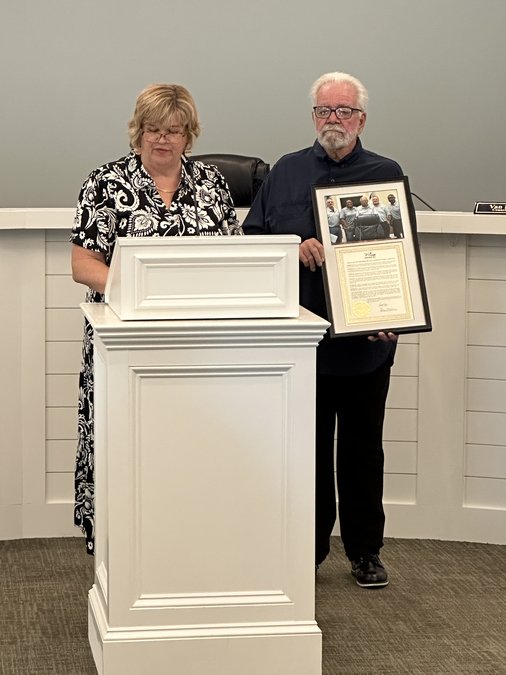
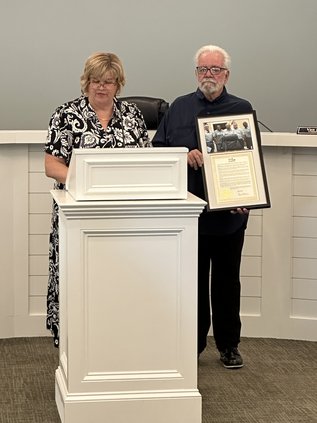
Albritton, who died in June at the age of 77, served on Richmond Hill City Council from 2004 to 2007 and was chairman of the city’s Planning and Zoning Commission when he passed, and Cox read a proclamation in his honor.
Cox said Albritton treated everyone with “respect,” and approached “every responsibility with honesty and good faith,” and his service to the community “extended well beyond city hall.” He was a member of the Richmond Hill Lions Club, served as a volunteer with the Great Ogeechee Seafood Festival and supported the Relay for Life and American Society.
Albritton, a Savannah native and member of the Georgia National Guard, moved to Richmond Hill with his wife Sheila in 1994, and was “known for his fairness, his integrity and his genuine care for the people of this city,” Cox said, noting,” whereas he gave much of his life in service to others, he will be remembered with gratitude and respect by mayor and council and by all who were fortunate to know him.”
A copy of the proclamation was accepted by members of the City’s Planning and Zoning Commission.
Millage rate
The new tax rate of 4.981 is 1 mill higher than the 2025 rate of 3.981, meaning the city will collect $1 more for every $1,000 of a property’s taxable value, which is capped at 40 percent of the assessed value.
The additional mill, following some additions and subtractions, essentially replaces the annual fire fee, which will no longer be billed after the city settled a $5 million class action lawsuit claiming the fees were actually a tax and illegal under Georgia law.
Richmond Hill will use 1.1 mills to fund fire protection and an additional 0.833 mills to help pay the settlement, but a rollback of 0.170 mills due to an increase in the tax digest and a reduction of 0.763 mills resulting from Floating Local Option Sales Tax collections dropped the overall increase to 1 mill.
The rollback the city adopted was less than the full 0.293 mills required by the most recent reassessment of property values, but the city said a combination of declining revenue, the cost of providing services, and the addition of costs incurred by the fire fee settlement.
The elimination of the fire fee could save property owners, who also may be eligible for payment under the fire fee settlement, money on their tax bills despite the higher tax rate, depending on property value and homestead exemptions.
An example provided by the city on its website shows the owner of a $400,000 home with no exemptions will pay only $160 for the extra mill, or $65 less than the $225 fire fee.
Under that same scenario, a senior age 65 or over with a $50,000 exemption would pay $110 on the additional mill, or $115 less than they would have paid for the fire fee. A disabled veteran with an exemption of $117,014 will pay $42.99, or $182 less than under the fire fee.
Mayor's Table
Cox announced at the conclusion of Tuesday's meeting that her monthly Mayor's Table meeting with residents is set for 9 to 10 a.m. Monday, Sept. 14, at City Hall and 6 to 7 p.m. at the Wetlands Center in J.F. Gregory Park. She said Bryan County Commission Chairman Carter Infinger has attended every meeting so far. The meetings are open to residents of both Richmond Hill and the county, she said.