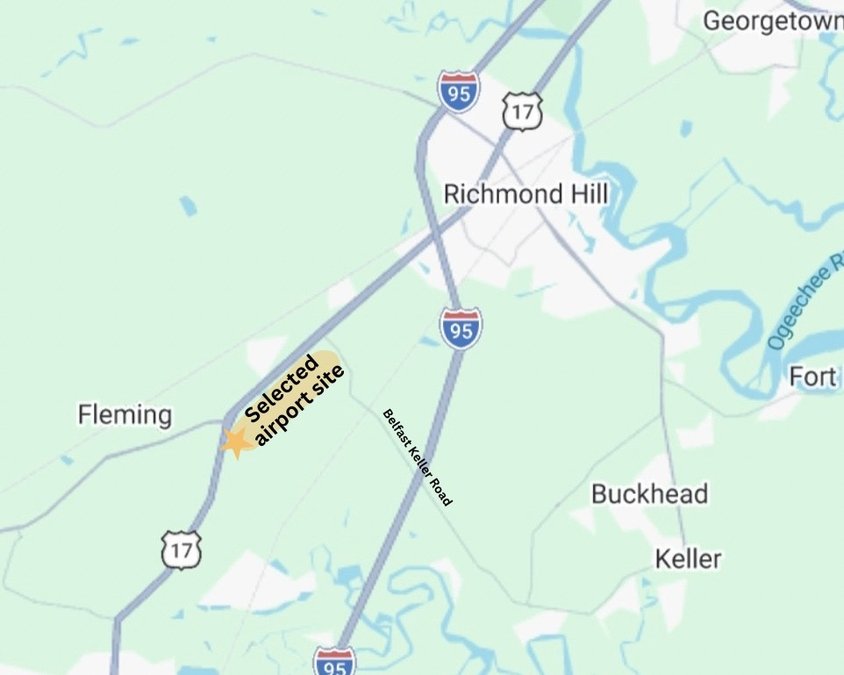
RICHMOND HILL – The construction of an airport in south Bryan County is still up in the air as the City of Richmond Hill discusses removing political and financial support for the proposed project.
The Richmond Hill-Bryan County Airport Authority was created by the Georgia Legislature in 2025 after both city and county sent letters in support of its creation. The authority is responsible for planning, developing and managing the airport, acting as the “landlord” for the airport. The proposed airport itself would be a general aviation airport that primarily supports non-scheduled, non-commercial civil aviation activities.
Airport Authority Chairman Trip Addison explained that Bryan County’s airport would be used mostly by private aircraft, with an emphasis on using the site for hangar storage.
“There are no available hangars for small or large corporate type aircraft in our region, and communities have been slow at addressing it,” Addison said. “While someone may live in Bryan or Chatham counties, they’ve got nowhere to hangar their aircraft, they’re going to keep it in Augusta or Columbia, SC – as far out as Alabama. What that means locally is those assets aren’t on our tax base as personal property.”
Addison said the airport would be a “very limited burden on the community that generates significant taxes.”
However, community response has largely not been supportive of the proposed project.
Bryan County residents have attended public meetings en masse to share their concerns about safety, environmental health, construction costs and property values.
In December, the Bryan County Commission voted to suspend funding for the proposed airport. The Commission wrote in a resolution that it no longer supported the spending of tax dollars, incentives or the incurring of additional costs for the airport project, which, after reviewing impact studies and a fiscal analysis, the county believed did not reflect the needs of the people.
County Commission Chairman Carter Infinger said the county would “maybe pick it up later.”
During the city’s March work session, Councilmember Cindy Hatala said she plans to introduce a motion at the April City Council meeting to vote on the city removing financial and political support for the project. She cited concerns about excessive costs, lack of public support and uncertain revenue from the airport.
But because the airport authority is a state entity, it can still move forward with the project.
GDOT evaluates airport capacity and future demand
Right now, the Georgia Department of Transportation is engaged in the Southeast Georgia Regional Aviation System Plan. This move is designed to “evaluate the operational capacity and performance of the region’s 13 airports, both today and as future demand grows,” a GDOT statement read.
GDOT wrote that the study is not being conducted to specifically determine the need for new air facilities but will provide “a comprehensive assessment of current aviation capacity and potential future needs in Southeast Georgia.”
Addison said GDOT is important in the potential airport’s construction because of its delegated authority under the Federal Aviation Administration.
Each of the region’s airports submitted their growth plans to GDOT by December.
“They will determine where the need is, what the need is and how they plan to fill that need,” Addison said. “What I’ve committed to as chair of the airport authority, and I think every member on the authority agrees, if GDOT doesn’t support the project, we’re not moving forward.”
The next hurdle would be an environmental assessment, required by the FAA. Addison said this assessment would look at air, land, water and cultural resources impact.
“If that comes back with impediments that we can't overcome, it's dead in the water, and the airport authority is committed to pulling support at that point,” Addison said.
Addison said the GDOT regional study will take about a year from its start in the Fall of 2025. An environmental assessment could take about 22 months.
He said a fiscal analysis showed the airport could generate tax revenue, equivalent to 800 houses, for the county. On top of tax benefits, Addison said the construction of an airport could benefit local students by providing potential learning opportunities for students interested in the aviation field. The proposed airport site would sit just a few miles from Richmond Hill High School.
Skepticism surrounds feasibility and demand estimates
Still, some Bryan County residents believe that the potential negative impacts of an airport outweigh the benefits and see the Richmond Hill City Council’s potential retraction of support as a step toward progress.
Mary Beasley, a Bryan County resident and retired air traffic controller of 28 years’, says that her primary concern with the proposed airport is safety. She spent decades looking at regional air traffic maps and said the planned Bryan County location is too close to existing airports and would be joining already congested airways that include restricted military operating areas from Hunter Army Airfield and Fort Stewart.
The Airport Authority denies these concerns, citing Holt Consulting’s site selection study.
Beasley has been vocal about these concerns, which she said have been missing from conversations in public meetings with local elected officials and even applied to serve on the airport authority to prioritize transparency to the public. However, the 11 positions went to local officials and business owners, including Richmond Hill City Manager Chris Lovell, who completed the final part of the two-part examination from the FAA to allow a pilot to fly solo, in 2023.
Bryan Mann, a Richmond Hill resident, said he’s concerned about the burden on local taxpayers. He criticized the city’s spending on feasibility and financial studies for the proposed projects.
The total cost of these studies adds up to about $300,000, with the first feasibility study dating back to 2023.
Mann said the airport authority’s projection of local aircraft registrations to potentially generate tax revenue if housed at a Bryan County airport seems unrealistic. He and Beasley both point to 93 responses from surveys that were sent out to 400 registered aircraft owners in Bryan, Chatham, Effingham, Liberty and McIntosh counties, by the Holt Consulting Group.
About 64% of those survey responders showed interest in relocating their aircrafts to hangars at a potential Bryan County Airport. Mann said that’s fewer housed aircrafts than the anticipated number reported in the Fiscal Impact Analysis.
“There’s no way it can be self-sustaining,” he said.
Mann also raised concerns about the project’s timeline and transparency. While conversations began in 2022, he said the public wasn’t made aware until 2025. He said he feels significant decisions on development – like the potential airport or proposed Westwin Nickel Refinery – are being made “behind the scenes” without significant input from residents.
As a five-year resident, he said he’s also concerned about the proposed airport’s proximity to new developments like the Del Webb housing community and a new hotel beside the I95 exit on Belfast Keller Road as well as to I-95.
Questions over project funding remain
The final feasibility study, completed in 2023, reports that the total estimated cost of the airport project would be about $128 million. Addison said 90% of the project will be paid from federal funds, while the state pays 5% and the Airport Authority pays 5% for construction of the runway. The FAQ sheet reads that the project will primarily use funds from the FAA’s Airport Improvement Program and Airport Infrastructure Grants for “federally funded eligible items.” This requires a 5% match provided by the Airport Authority, which it plans to provide through revenue bonds.
“The airport authority doesn’t want to own any vertical assets so our preference is any vertical asset would be owned by a private, individual company that’s taxable,” Addison said. “The total cost – majority would be private development.”
Addison said this means no local taxpayer money would be used for the project.
However, the feasibility study did cite an estimated local cost of $62,467,150 for the entire airport project.
“They say that the taxpayers aren't paying, but the taxpayers already paid $300,000 for studies, " said Corey Foreman, a Bryan County resident and Georgia Senate candidate. “So, you can't say they're not paying anything.”
Foreman said if the city votes to retract support, it’ll be a step in the right direction.
“Nobody controls the airport authority except the state,” he said. “The only thing that can be controlled from the county and the city is land, money and support. The city not supporting the airport also means the city's not going to support zoning changes for the airport.”
Foreman also pointed out that it may be more challenging for the Airport Authority to receive FAA funding to construct an airport without city or county sponsorship.
“If the city suspends their support … along with the county, then the airport authority has nowhere to go except operating by themselves,” he said.
Lucille Lannigan is a growth and development reporter with the Bryan County News. Reach her at llannigan@morrisnews.com.