Lucille Lannigan, Growth and Development Reporter
PEMBROKE – Bryan County engineers presented a plan to ease the Hyundai Motor Group Metaplant America’s groundwater usage Thursday.
The project would connect North Bryan County’s water system to the newly constructed water treatment plant in neighboring Effingham County, an alternative that engineers said would reduce the dependency on withdrawal from the Floridan Aquifer. Bryan County is located within the yellow zone of the Floridan Aquifer, which means it has a limited groundwater withdrawal capacity to mitigate saltwater intrusion.
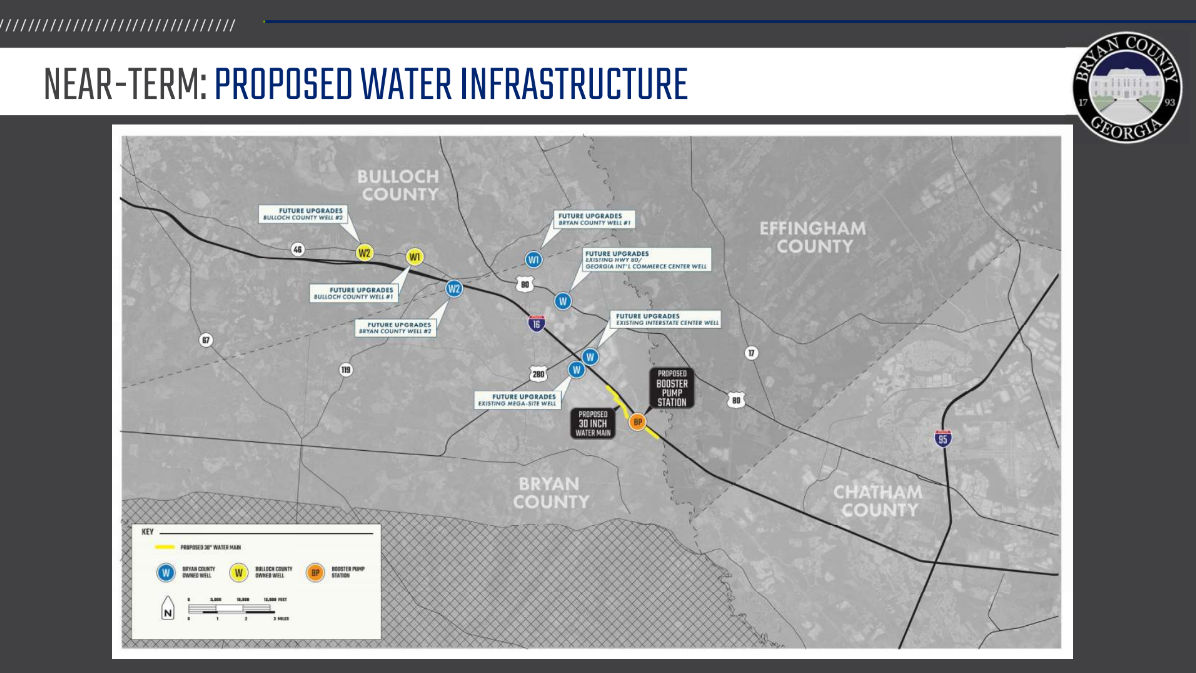
When HMGMA opened in Ellabell, the plant’s water use became a point of contention due to the strain it would put on water resources. Four industrial wells were drilled in neighboring Bulloch County, which is in a green zone, to supply up to 6.6 million gallons of water per day.
“The primary and first goal here is to replace the Hyundai water that we’re using right now, that we’re drawing from the Bulloch wells … to replace that as an entirety so that anything that’s going to that plant will be coming from surface water from Effingham,” Kirk Croasmun, Bryan County’s engineering director, said.
The capital cost of the Bryan County project is estimated to be between $30 and $40 million. Croasmun said county residents will not bear the cost, citing funding from the Drinking Water State Revolving Fund and the American Rescue Plan Act.
The surface water extension project is just a portion of a $500 million water infrastructure package, approved by the state in March 2025 to construct a new Effingham County surface water treatment plant. It will be the second one in Coastal Georgia. Croasmun said Effingham is still working with Savannah on the first phase of the project.
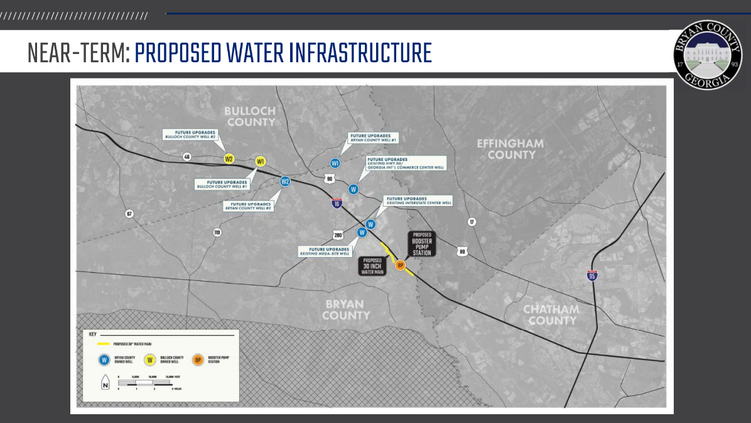
The Bryan County portion of the project is expected to begin in early April and the duration is estimated to be 200 days. Tyler Davidek, the project manager with Thomas & Hutton, an engineering firm, said the project includes an extension of the 30-inch water transmission main, the installation of one new booster pump station and chemical upgrades to seven existing wells.
Alternative project proposals included tapping into the Savannah water supply, the building of a cretaceous reverse osmosis water treatment plant or the consolidation of water systems from the City of Pooler, Liberty County and Bulloch County well systems. Davidek said these alternatives proved to be too costly and failed to meet the timeline for North Bryan County’s anticipated developments. The region’s population is projected to grow from about 48,000 to about 57,200 by 2030 and increase to about 77,700 by 2045, according to the U.S. Census and Governor’s Office of Planning and Budgeting.
Davidek said the water main itself wouldn’t be tapped directly into residential water supplies.
“It’s (the water main) going to feed the entire system,” Davidek said. “This is to provide another connection point and another supply to Bryan County.”
Assessments from the presentation showed minor environmental impacts on wetlands, water supply, water quality, water resources, forest land, soil stability and more.
A small group of public attendees listened in and posed questions about the capacity of Effingham’s water treatment plant. Croasmun said that the Bryan County lines would be connected before the new treatment plant is built in Effingham County.
“We’ll start receiving water … coming from Effingham but supplemented by Savannah,” Croasmun said.
Bryan County resident and Georgia Senate candidate Corey Foreman asked what Effingham County plans to charge Bryan County for the water supply. Project presenters didn’t have a clear answer.
Croasmun said he guesses Effingham will set a bulk rate.
“We haven’t gotten into the details yet,” Croasmun said. “Whatever that rate’s going to be set to .. that has yet to be determined.”
Foreman also questioned why this surface water extension wasn’t the plan from the start of HMGMA.
“The amount they’re pumping – wouldn’t it have been better to take that front he surface water to start with opposed from taking from the groundwater,” he said. “They’re kind of working backwards.”
Croasmun said it was a timing issue.
“We were under a short time constriction to get water to the Hyundai Plant,” he said. “It was the best option at that point. There was a lot more discussion after the fact and that's how we came up with the surface water program and then the state obviously helped by contributing a lot of money for that.”
One public attendee asked about the future of the Bulloch County wells.
“We have not totally come to a conclusion on that one yet,” Croasmun said. “To your point, there was a lot of money spent on the infrastructure, right? So, again the primary objective here is to replace the Hyundai water and get them off the ground water, and then I think there’s going to be more discussion on what happens with the infrastructure and move forward.”
Lucille Lannigan is a Growth and Development reporter with the Bryan County News. Reach her at llannigan@morrisnews.com.