
My earlier column, on the Spanish-built fort the “Castillo de San Marco” in nearby St. Augustine, FL, closed out the “mini-series” on coastal area forts that popped up while I was writing about other places. My last column, on the important East Coast city of Baltimore, resumes relating adventures I’ve had in numerous cities across this great country.
Brunswick, Georgia, is not some exotic, far-off place, like some places I’ve been to. But it’s an interesting place, in its own right; I have many connections with the area, both business and personal.
Also to neighboring Darien (which I have written about before), Jekyll Island and St. Simons Island.
All have their own distinct charms.
Brunswick is a relatively small town, anchored mostly by two industries: seafood and shipping. The Georgia Ports Authority has a major automobile and heavy equipment processing facility on Colonel’s Island, just across the Brunswick river, south of the old downtown. In recent years the volume going through that facility has grown to the point it has eclipsed the nearby port in Jacksonville, Florida, and provides a major economic boost to the town.
Tourism is also a big part of the local economy, but moreso perhaps for Jekyll and St. Simons Islands. Jekyll is of course very popular for summer travelers, especially for families with children, who go to enjoy the beaches and golf courses. The Jekyll Island Convention Center hosts a number of gatherings each year, conveniently located in the center of that island. It is a very nice facility; my wife and I have enjoyed going to several Rotary District Conferences there.
Brunswick was in the news a lot in recent years, due to the capsizing of a huge car carrier ship, The Golden Ray, as it attempted to leave the port in the middle of the night on its way to its next port of call, Baltimore. At the time, it was carrying over 4000 Hyundai and Kia cars, and a crew of two dozen sailors, all of whom were eventually rescued with no loss of life, including four poor souls who were stuck inside the bowels of that ship for a hot and harrowing 24 hours.
The Coast Guard eventually concluded the ship had not been properly balanced, when it left the port, and was top-heavy, causing it to tip sideways as it turned in a bend as it was heading out to the open waters of the Atlantic Ocean.
Fortunately, the local harbor pilot on board realized immediately what was happening, when it began to list, and had the presence of mind to drive that mammoth ship onto a sandbar, to keep it from sinking into the channel. He undoubtedly saved the live of the four souls down in the engine room, and kept a bad event from becoming much worse.
That ship then spent the next several years sitting on its side on that sand bar, off the northern end of Jekyll Island, thankfully not blocking the shipping channel. Because of its being top-heavy with cars, and having lost all power when it capsized, it was determined not feasible to try to pull it upright and then tow it somewhere. So the decision was made to cut it into pieces, and haul off the pieces instead.
That was of course a major operation, and took lots of careful planning.
The Brunswick News ran a continuing series of articles, complete with many striking photos, while that removal operation was underway. The ship was clearly visible from the St. Simons Island pier, so that became a prime viewing spot over the next couple of years. My wife and I made many trips there to watch that process unfold; it was a once-ina- lifetime event. I will never forget the sight of that huge ship, on its side, sticking up like a sore thumb, dominating the view from both islands.
What an expensive mistake! The ship alone cost over a billion dollars ($1B) just to build; plus the 4,000+ brand-new cars on board that had to be scrapped. Plus the cost of cutting the ship into pieces, which then had to be loaded on barges and hauled off to a recycling plant in Louisiana – a long, slow process. I don’t think I ever saw a final figure for the total cost.
Thankfully, the environmental damage was minimized, thanks to the careful pre-removal planning. It could have been much worse. And if the harbor pilot on board as the ship left Colonels Island had not acted so quickly, it could have sunk in the middle of the shipping channel, instead of lodging on that sandbar, blocking all ship traffic.
Look at what happened last year in the Baltimore harbor, when that huge freighter lost power and struck the long bridge over the Chesapeake Bay! Brunswick was spared that nightmare.
Next up: More on the old downtown.
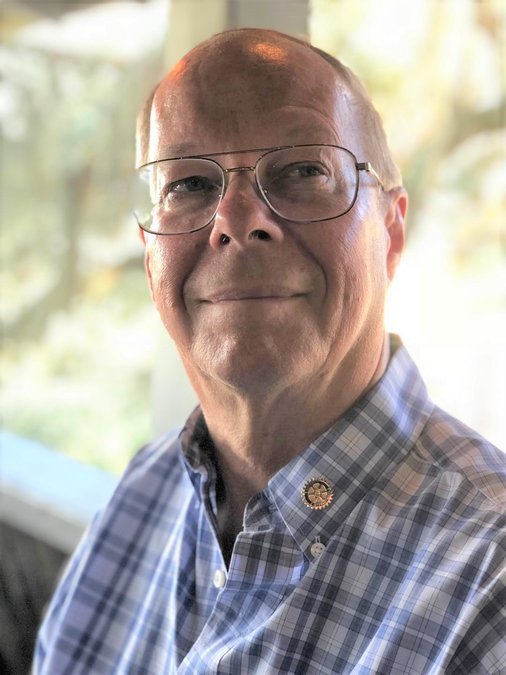
Rafe Semmes is a proud graduate of (“the original”) Savannah High School and the University of Georgia. He and his wife are both long-time Rotarians, and live in eastern Liberty County with their changing passel of orphaned rescue cats. He writes on a variety of topics, and may be reached at rafe_semmes@ yahoo. com.