STATESBORO – It’s been six months since International Paper shuttered the doors on its Chatham and Liberty County mills, and the impact has cascaded throughout southeast Georgia’s timber industry.
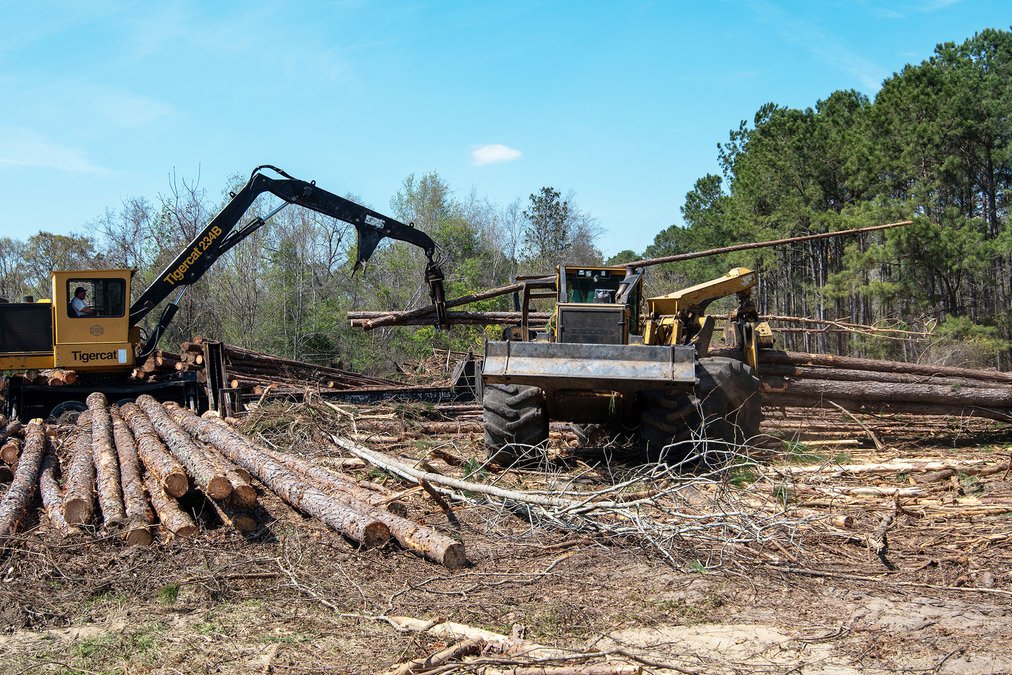
The closures have devastated the demand for pulpwood, a cornerstone in the industry. The Georgia Forestry Commission reported that mill closures caused about 8.3 million tons of Georgia timber to lose a market – roughly 290,000 log truckloads. The harm travels down the supply chain to mill workers, loggers, truck drivers, and contractors.
The U.S. paper and pulp industry has been declining for a while. Amanda Lang, the president and COO of Forisk Consulting, a forestry research and advisory firm, said there’s been a 20% reduction of pulp mill use in the last five years, a “really big decline” in such a short period.
Still, stakeholders across the industry couldn’t have predicted the scale or the speed with which southern U.S. mills closed.
“The scale of the closures that have happened over the last three years in the U.S. southern region has been dramatic – far worse than what we thought,” Lang said.
At least 29 pulp mills have closed across the U.S. since 2019, with significant closures concentrated in Georgia, which saw five major mill closures in 2025 alone.
For area foresters and timberland owners, the closures meant scrambling to find new markets to sell their timber. And in Liberty County’s Riceboro, it means that a large industrial site and a once-significant employer of Liberty County residents, sits empty, its future uncertain.
Minds from the timber industry, legislature and Georgia’s universities are coming together to brainstorm innovative solutions – whether it’s short-term relief strategies and longer-term transition into innovative markets.
Lang said that underlying these efforts is a fundamental advantage: supply. She said the southern U.S. grows 60% more wood than the industry uses each year.
“Georgia's a part of that,” she said. “We have a lot of material to use, and we're sustainable. I think those are two really positive messages and two things that are going to continue to attract industry to our region and our sector.”
Industry struggles as pulp market collapses
On the timber side of things, foresters are scrambling to sell wood that no longer has a market. Landowners are forced to question the viability of maintaining their timberland.
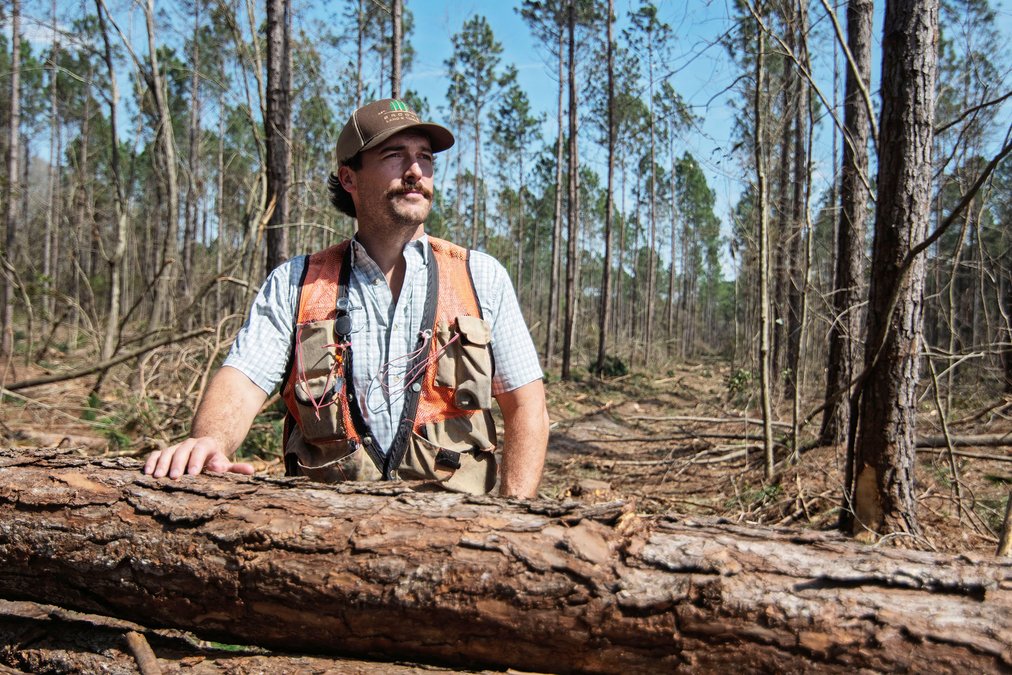
Jase Brooks, owner and founder of Brooks Land & Timber, a Statesboro-based forestry consulting firm, said the same wood that sold for roughly $16 per ton, when he first started his business in 2020, now goes for about $4 a ton.
When Brooks faced the mill closures, he said he jumped to start an export yard where he could send wood overseas, mostly to southeast Asia.
“We have contractual duties for clients … my immediate, knee-jerk reaction was ‘where are we going to send this wood,’” he said. “I’ve been exporting for six plus months now. It was a way to remediate my loggers not having a place to send wood. It’s allowed these guys to make a full week’s worth of work.”
The added challenge also came while foresters were still recovering from Hurricane Helene, which accumulated an economic loss of $1.28 billion for the state’s timber industry when it struck in September 2024.
“The last two years for the forestry world has been an absolute dumpster fire,” Brooks said. “We’re just trying to come up with alternatives and ways to be competitive in the market and have outlets for wood. It’s adapt or die.”
Despite the hit to the industry, Brooks said his client list continues to grow.
“The question my clients are asking is how do we make the numbers work?” Brooks said. “How do we make being a forest landowner work for the next generation?”
He said some are deciding they can’t make it work and selling their land, largely for development.
Riceboro Mill closure
Devon Dartnell, the forest utilization chief with the Georgia Forestry Commission, said forest land acreage declines across Georgia each year. While some of these lands transition to agriculture use, he said in Coastal Georgia it's primarily transforming into developments – housing, industry, commercial, etc.
The Riceboro mill’s closure marked the end of an institution that shaped generations of Liberty County families.
When International Paper bought the mill in 2024, it had about 300 employees. When IP announced the closure in August of 2025, local leaders got to work on short-term relief, focused on workforce transition.
Brynn Grant, president of the Liberty County Development Authority said within three weeks of the closure announcement, the county organized a job fair directly across from the plant, drawing nearly 300 job seekers and about 25 employers. Grant says the region’s broader economic growth helped absorb some of the shock, with nearby manufacturers offering opportunities for displaced workers.
Still, she said the full economic impact on Liberty County – the long-term consequences for its tax base, landowners, and forestry-dependent businesses – may take years to surface.
“We’re fortunate that our region has so many job opportunities for people like the skilled workforce at the mill,” Grant said. “I think the bigger economic issue for our county and for our region will be the forestry industry.”
That uncertainty has fueled a push for proactive solutions. In February, regional stakeholders hosted a Forestry Solutions Summit in Liberty County. There, industry, academic and policy stakeholders discussed potential new markets and industries. Grant said the summit was led by the Devendorf-Belford Tree Farm, a longstanding timberland family in the county.
“We came to their aid because we wanted to see solutions, and we want to attract solutions,” she said.
Grant said a future summit is being planned for June.
The future of the Riceboro site itself remains unsettled. Grant says it is highly unlikely the facility will ever operate again as a paper mill, given the industry decline. Instead, the site is being marketed for new industrial uses. Grant said International Paper is reviewing multiple proposals from potential buyers of the site, while coordinating with local officials.
(Bryan County News reached out to International Paper for an update on the mill’s future but did not receive a response by publication.)
One key factor is water. Grant said the Development Authority’s manufacturing focus is on low water using industries. The former mill operated under a permit allowing roughly 11 million gallons of daily water use, but that allocation will not automatically transfer to a new owner. Grant said any future operator will need to apply for a new permit based on its specific process.
For Liberty County – designated as a “yellow” water-use area with EPD – this is a critical limitation. Grant said when the paper mill was in operation, the county had to turn away projects with high water demands.
A report from The Current said the closure of IP mills has led to recovered Floridan Aquifer levels.
Grant said IP remains communicative with the Development Authority about the Riceboro mill’s future. She said the Authority hopes for an industry that will improve the county’s standard of living through jobs, tax base growth, and responsible industry.
Despite industry challenges, there is cautious optimism. Industry leaders emphasize the resilience of the resource and workforce, but agree that recovery—particularly in the pulp sector—will be slow and uncertain.
New paths for a changing timber industry
In September, Gov. Brian Kemp formed a forestry task force made up of representatives from the Forestry Commission, the Department of Economic Development and experts from Georgia Technical University and the University of Georgia to respond to mill closures.
“We all put our heads together to envision what short-term, medium-term and long-term solutions were,” Dartnell said. “We came up with a proposal and submitted it to the Governor’s Office in January, with lots of recommendations, some of which are currently being considered to be funded by the legislature during this session.”
Georgia House Speaker Jon Burns said the state has invested more than $250 million in state funding aimed at disaster recovery and industry stabilization in response to Hurricane Helene.
The state legislature passed HB1000, a one-time individual tax credit, in mid-March. Burns said this will benefit foresters.
“Our plan is … in the forestry industry … for them to be able to monetize their tax credits by making them transferable, and that will allow them to invest those dollars back into their companies … so they can stay in business or have an opportunity to reinvest,” Burns said.
Burns said he and other state leaders are pushing to expand wood exports. However, he said there needs to be more predictability in trade policy, including a proposed 90-day notice before tariff changes, for this expansion to work.
He said the state is also supporting research efforts at Georgia Tech toward innovative industries and alternative markets.
Dartnell said among the most promising of those markets are bio-based fuels, including biomethanol for shipping and sustainable aviation fuel, as well as biochar, which can be used in applications ranging from soil enhancement to steel production.
“It's difficult to make transportation fuels out of wood, but it is possible,” Dartnell said.
While commercialization will take time, Dartnell says these emerging markets could eventually be an alternative to pulp demand.
Dartnell said wood biomass electricity plants are a low-hanging fruit – plants that would burn low value wood instead of coal, to generate power.
“It’s not quite as cheap as coal or natural gas, but it’s a huge market,” he said. “We know we need electricity, especially if data centers and AI electricity demands come to fruition.”
More possibilities for the industry
Burns said there may even be potential for former mill properties, like Riceboro’s, to be repurposed for energy production, particularly given their existing infrastructure for handling biomass. That could include facilities that generate power from wood waste or other renewable inputs, offering a partial bridge between the region’s forestry base and emerging energy markets.
Another major opportunity lies in mass timber construction. By engineering wood into large structural panels, developers can replace steel and concrete in multi-story buildings.
Dartnell said this market is projected to significantly expand in the coming decade, potentially adding billions of board feet in annual lumber demand. That’s a substantial growth opportunity for Georgia, which already produces about 4.3 billion board feet of lumber each year – more than any state in the U.S.
There are also signs of resilience within existing markets. Lang said while pulp has declined, other sectors remain stable or are poised for growth. Demand for packaging materials, wood pellets, and construction products like oriented strand board continues, while some mills are still expanding or upgrading facilities. American Industrial Partners recently purchased mills in Oglethorpe and Port Wentworth, GA from IP, in January.
“I’m still very optimistic about the timber industry in Georgia and in the U.S.’ southeast as a whole,” Lang said. “We as a society need wood and wood products, and I think that’s going to continue. I think the industry in Georgia is fundamentally different. These were really big mill closures. But I think landowners are going to adapt and adjust.”
Lucille Lannigan is a growth and development reporter for Morris Multimedia. Reach her at llannigan@morris.com.