By Lucille Lannigan, Regional Growth & Development Reporter
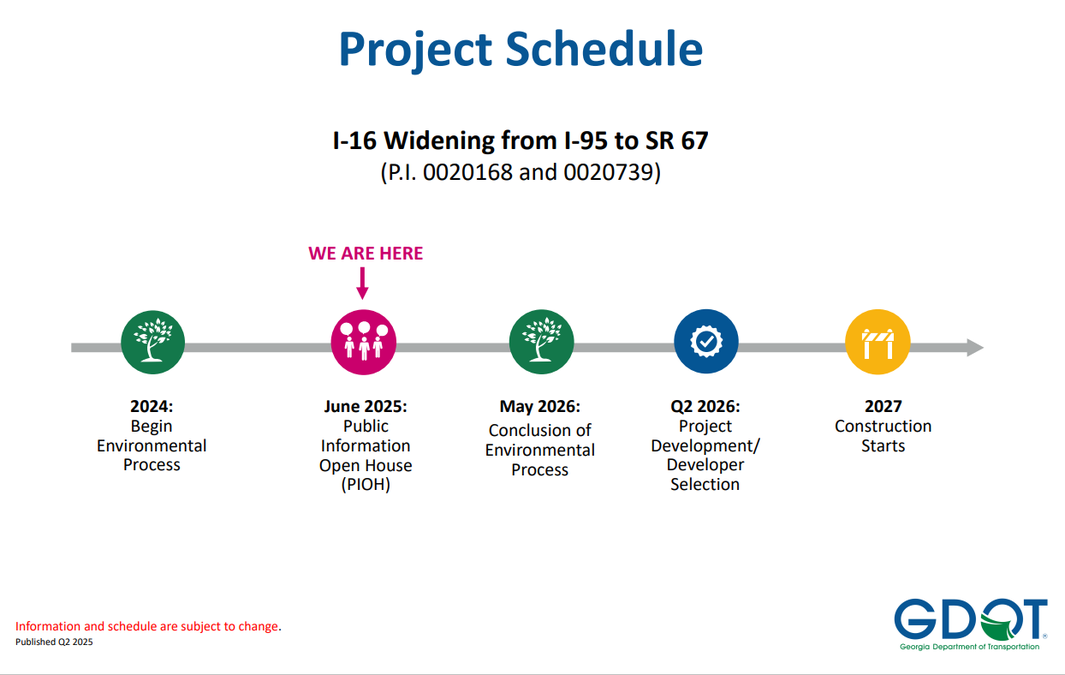
With construction still slated to begin early 2027, Coastal Georgia’s I-16 widening project’s environmental review process is underway.
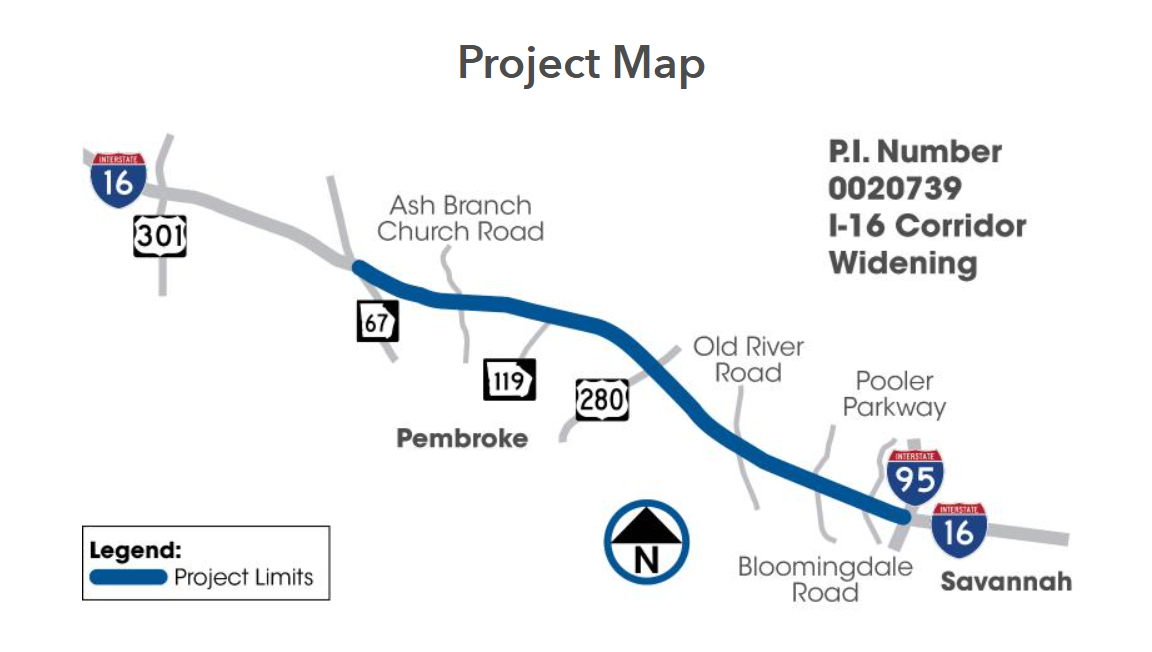
The proposed project, announced last May, would widen I-16 from two to three lanes in both directions between I-95 and SR-67 across Bulloch, Bryan, Effingham and Chatham counties – a 32.5-mile stretch. The estimated cost is $522 million. The Georgia Department of Transportation (GDOT) is conducting environmental assessments in accordance with state and federal requirements.
“This work ensures that potential impacts to natural, cultural, and community resources are thoroughly evaluated and that the project moves forward responsibly,” a statement from Kyle Collins, GDOT communications manager, read.
Environmental studies will examine impacts to communities, historic and archaeological resources, waterways and wetlands, threatened and endangered species, air quality and traffic noise. Results are expected to be available for public review by summer 2026.
Environmental advocates weigh in
Damon Mullis, the Ogeechee Riverkeeper, said between the Port of Savannah’s expansion and the construction of the Hyundai Motor Group Metaplant America in Ellabell, his group is monitoring an influx of development in the region.
“It’s a natural progression that once industry and people start moving ahead, you have to address infrastructure,” he said. “We’ve definitely seen a huge increase in … all development, not just road projects, but housing development, warehousing and industrial development.”
Mullis said with increased infrastructure and construction, comes increased risks to the region’s waterways. Dirt is the number one pollutant in Georgia’s waterways.
“No matter what kind of development, we start to see issues with erosion and sedimentation,” he said. “The larger the development, the harder it is to keep silt, dirt out of the waterways.”
Stormwater also becomes an issue as more land is built up and becomes flat, hard surfaces.
“You’re changing the whole hydrology of the area,” Mullis said. “Where that rainwater typically goes into the ground and slowly migrates into the rivers and streams … now it runs across your surfaces and goes directly into our rivers. The fluids don’t have a chance to assimilate or kind of be cleaned by the soil.”
Brian Gist, a senior attorney with the Southern Environmental Law Center, said road projects become more precarious when the roads cross water bodies or pass through wetlands. He said it's especially important for climate change to be considered in coastal Georgia infrastructure projects.
“This is infrastructure that lasts a long time; so, we’re planning not just for conditions today but what we anticipate conditions to be like in the future,” Gist said.
Gist emphasized the importance of the public’s awareness and participation as the project progresses.
This project’s public comment and open house period was held in June 2025. The project hosted in-person meetings in Bulloch County and Chatham County. Collins said all public comments were reviewed, and a response letter can be viewed at this link: https://i16-widening-0020168-gdot.hub.arcgis.com/
Taking the proper precautions to grow
While the full scope of environmental impacts is still being determined, Collins confirmed that some wetlands within the project corridor may be affected, temporary, localized increases in dust and engine emissions may occur during construction. Watershed impact analyses are still ongoing. The project will include the widening or replacement of 20 bridges in 10 locations.
Collins said the project calls for the interstate highway to be widened within the existing, developed right-of-way, by adding a third 12-foot travel lane in each direction. Existing lanes “will be realigned towards the median” and the additional lanes built “in the median area.”
Impacts to any habitat present for protected species would be reviewed by the U.S. Fish and Wildlife Service to ensure impact is not significant. Any species that face impacts would be provided additional protective measures.
Air quality analysis will be conducted prior to construction to assess long-term impacts on air quality within the project corridor. These findings will be included in the publicly available environmental document.
“All possible measures are being taken to avoid or minimize impacts,” Collins wrote. “Georgia DOT complies with all state and federal guidance regarding environmental protection. The same is true for any contractor working on behalf of Georgia DOT, as they are contractually bound to follow all legal processes that ensure best practices are followed.”
He added that the permitting process includes investing in mitigation banks that restore, enhance or protect wetland ecosystems.
I-16 corridor
Trip Tollison, the president/CEO of the Savannah Economic Development Authority and board member for the Savannah Harbor-Interstate 16 Corridor Joint Development Authority said the I-16 corridor has long been established as the region’s industrial corridor.
“It is our opinion that it (industry) needs to be concentrated and focused on a certain corridor versus a bunch of one-offs everywhere,” Tollison said. “I don't think that's good for planning. I don't think that’s good for the environment.”
He said the widening project’s completion will see more efficient, safer traveling along I-16, especially with the industrial traffic that comes in and out of the port. Data from GDOT shows that average daily truck percentages for the project area range between 20 and 25 percent. This specific project is mentioned in the 2023 Coastal Empire Study list of projects recommended for implementation “as quickly as funding allows.”
State funding through the “Georgia Freight Program” accelerated the timeline of the widening project.
Collins said it is likely the expansive project will be broken into smaller “design-build” construction projects as funding becomes available.
“We’ve done a lot of work with our state partners,” Tollison said. “We can’t have growth without the infrastructure so thankfully we’re putting our money where our mouth is. We’re very excited.”
The environmental process for the proposed I-16 Widening Project is predicted to conclude in May. GDOT anticipates project development/developer selection to happen in late 2026.
As for when project construction will be finished? Collins said it’s too early to know. He compared the project to a Design-Build widening to the inside median on I-85 in Northeast
Georgia, which saw several phases around 8-10 miles each and took 2-3 years of construction each to be open to traffic.
“It’s a part of the growing pains,” Tollison said. “If there’s a headline we want to get through to people over the next several years, it’s ‘please be patient.’”