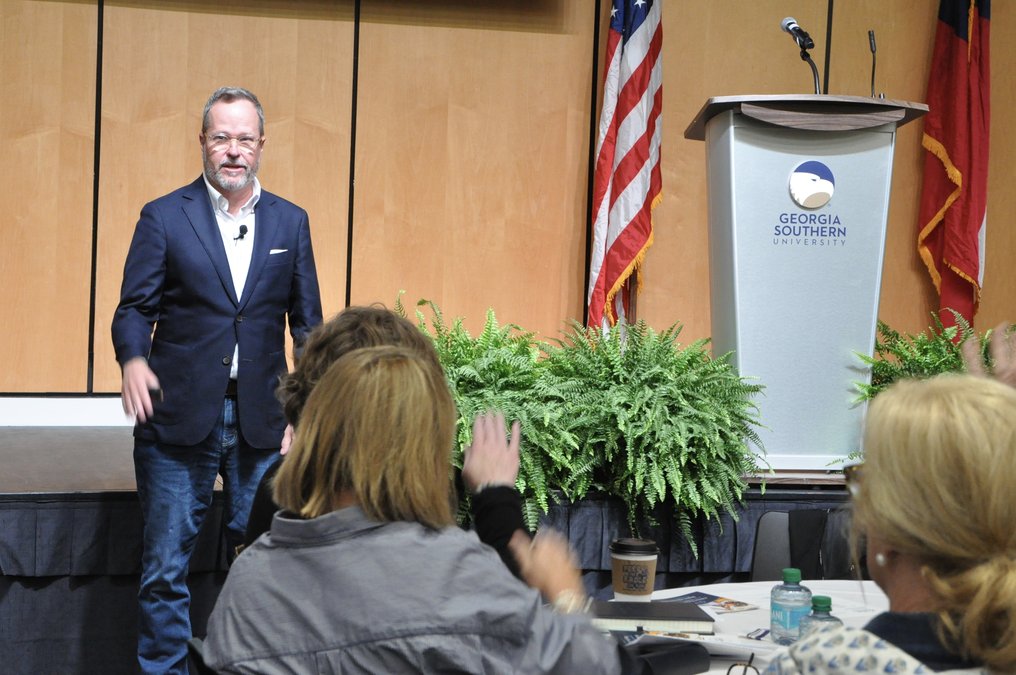
STATESBORO – Early childhood literacy and AI resilience are key challenges to overcome for Georgia’s workforce, according to experts at the Georgia Chamber Foundations Regional Roundtable held Tuesday at the Georgia Southern University campus in Statesboro.
Georgia Chamber President and CEO Chris Clark shared a regional workforce overview as experts from across the region’s education space talked about the significance of early childhood literacy in developing a stronger workforce. Clark also named AI resilience as a key need when confronting the future of Georgia’s job market and labor force, especially as AI potentially threatens entry-level jobs.
“If you don’t have that entry-level job, how are you supposed to get ready for the next level?” Clark said during his presentation. “Just like if you don’t understand literacy by third grade, how are you going to be ready for fourth or fifth or anything else?”
Georgia has had seven record years of economic growth, and Clark said that the state’s coastal region is driving that growth – something that couldn’t be said 10 years ago.
He chalked that growth up to regional collaboration and coordination, attracting major economic transformers such as the Hyundai MotorGroup’s Metaplant America and its suppliers.
“It wasn’t just a Bryan County project,” Clark said. “It’s a regional project of significance. But the leadership in the area came together to work with them … the university, the technical colleges, everybody. I mean, this region was recruiting an automotive company for 27 years before we finally got one, and then everybody's been ready for it, and organized quickly to help them have the impact they've had.”
Despite this economic success, coastal Georgia is in the same boat as the rest of the state in having to confront literacy challenges and this new wave of AI.
So, where does the state and region stand?
Coastal Georgia’s AI resilience level
In Clark’s regional workforce presentation, he shared that while AI was shown to increase workplace productivity, it also translated to an almost 11.5-percent reduction of jobs.
“You’re going to see about 92 million jobs globally gone in the next five to 10 years because of automation and AI,” he said. “The question becomes, are our children and our grandchildren ready to compete in an AI world? Are their careers going to be AI-resilient?”
Clark said key focus areas will be making sure youth are given the right career pathways after high school, are taught practical skills such as focus and attention, are developing entrepreneurial skills and are able to understand data and logistics.
In a post-presentation interview with Morris News, Clark said he believes coastal Georgia is more resilient than other states to the AI-job takeover.
This is because of the region’s diverse industry sectors – manufacturing, port jobs, healthcare and tourism, all of which are among the most AI-resilient jobs.
“AI is not going to unload that cargo ship at the Port of Savannah,” he said. “AI will help do that, and it will help at Hyundai, but it’s not going to replace those workers that are running the machine.”
“I think the critical thing for this region, for everyone in Georgia, we’ve got to figure out how to use AI to create new jobs, too,” Clark said. “Help that younger generation leverage that technology and tool, not just to be a place where we build and make stuff, but also, we create and imagine things.”
Coastal Georgia’s early literacy mission
Dr. Dana Rickman, president and CEO, Georgia Partnership for Excellence in Education, said Georgia is in an “era of a workforce crisis.”
“We continue to see demand across industries like manufacturing, healthcare, transportation, and others,” she said. “Employers are hiring, but there's a mismatch.
Due to a combination of factors, we are on the cusp of creating a massive new unworking class. These are sort of unemployable people. They don't have the skills necessary for the jobs that are available.”
The key to combating this is ensuring that high school graduates are going on to obtain post-secondary credentials, whether it’s a four-year degree, two-year degree or skill certification.
In Bulloch County, about 28% of the population doesn’t have a degree beyond high school.
“That’s a problem,” Rickman said.
However, Rickman and other expert panelists emphasized during Tuesday’s discussion that this problem can’t be addressed until early literacy is first addressed.
“Any student, no matter their background, if they have the resources, the support that they need to learn to read by the third grade, they have just as much probability of graduating high school on time as anybody else,” Rickman said. “So, it's not an achievement gap. It's a resource gap.”
Dayle Burns, a retired educator and wife of state Speaker of the House Jon Burns, talked about the Georgia Literacy Act of 2026, a state law signed this year that overhauls early childhood reading education from kindergarten to third grade to address the state’s lagging literacy rates. She compared Georgia’s literacy crisis to a pulled fire alarm.
“This is a serious issue,” she said. “We all got to get up and do something about it.”
How is coastal Georgia combating that resource gap?
School districts, including Bulloch’s and Effingham’s, created literacy councils – collaborative groups of educators, literacy organizations, business and civic organization leaders and community volunteers – working to increase kindergarten readiness for students from birth to pre-kindergarten.
Crystal Simpkins, the director of early learning and literacy for Bulloch County Schools, said Bulloch’s school district has been tackling early literacy for about six years, and she was excited to see the Georgia Chamber emphasize it as an economic tool.
Simpkins said the Bulloch READ initiative focuses on reading, literacy-rich environments, access to books and early brain development. The council provides books through its book bus and more than 50 community reading locations at local businesses and parks. The council also connects parents with resources to help prepare their children for school.
Simpkins said the council hosts community literacy events, parent workshops and professional development for child care workers.
Through a partnership with the Georgia Department of Early Care and Learning (DECAL), the council offers Saturday training sessions to help child care workers meet state requirements. Simpkins said the council has received $250,000 in DECAL grants over the past four years to support community literacy efforts.
She said the council’s next step is to focus more on supporting parents and children together through a “two-generation” approach. Simpkins said that she’s even worked with parents who are learning to read alongside their children, thanks to the Literacy Council’s resources.
“That’s major. We’re not just giving books, we’re providing support to the families,” she said. “If our children aren’t educated, if their families aren’t educated, how do we have a strong workforce?”